Showing posts with label adaptation. Show all posts
Saturday, 18 August 2012
Abraham Lincoln: Vampire Hunter
I can see why people wouldn't like this film. It does go a little CG-I crazy, and some of the action set pieces are a bit far-fetched. And Jimmi Simpson's accent is more than a little bit iffy. But the acting is very solid and it ties in a lot of the things from Lincoln's actual life very well and-... Wait, what was that? This film is too serious? Are you kidding me?! So, Abraham Lincoln destroying vampires with an axe that also transforms into a shotgun is too serious? ... You guys have an odd sense of serious.
Based on the book by Seth Grahame-Smith (who also wrote Pride and Prejudice and Zombies), this basically tells the history of Abraham Lincoln (Benjamin Walker), but with vampires. When he's a youngster, Abe sees his mother killed by a vindictive vampire Jack Barts (Marton Csokas), and grows up harbouring a wish to avenge his mothers death. After almost being killed by Barts, he gains a mentor in Henry Sturgess (Dominic Cooper), another vampire (but a good one, not an evil one) who trains him to be a vampire hunter. Fighting these monsters inspires Lincoln to pursue a political career. Eventually, he puts his slaying days behind him in order to protect his wife, Mary Todd Lincoln (Mary Elizabeth Winstead), but is forced back into his old ways as the civil war approaches and the southern forces use vampires to help them, lead by Adam (Rufus Sewell).
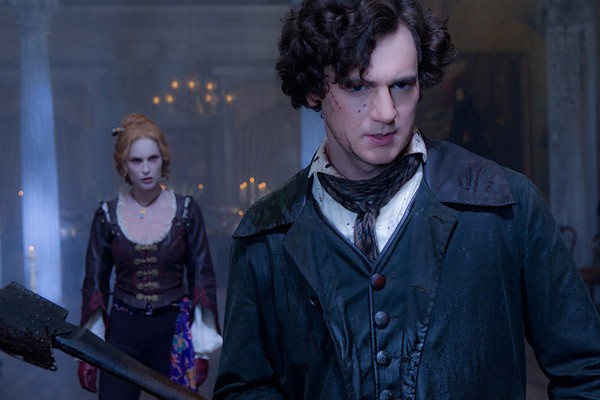
I'm sure if you know more about Lincoln's life you will get more out of the way the historical events are portrayed in the story. But even if you don't (and I certainly didn't) you still get a fairly enjoyable and easy to follow story out of this. But really, this is too serious? I think that's one of the weirdest complaints for a movie I've heard. People seemed to think that this was meant to be a tongue in cheek tribute to the man. But the premise is so tongue in cheek already that if it was any sillier then it wouldn't have worked. Instead, they took a slightly silly idea and made it epic! And when a film is filled with silly sounding scenes, like Abe's training montage (a freaking training montage!), and they give them a serious edge, it adds a little gravitas to the occasion, and makes it awesome!
The acting is superb in this, even the slightly odd choices of Jimmi Simpson as Joshua Speed and Mary Elizabeth Winstead as Mary Todd Washington (mainly because I've only seen them in teen movies). Everyone is really bloody good, but of course the star is Benjamin Walker as Lincoln, who behind the serious facade you can tell is having a lot of fun. He manages to be an action star whilst looking like he belongs in a period drama, which is the perfect mix! Rufus Sewell as Adam is also good, and wonderfully hammy in some parts, but not so much that he loses his menace. Although the person who steals the film with his performance is Dominic Cooper as Henry. He gives a rather honest performance of a man who has lost everything yet continues to fight against those who must be stopped, and in the end becomes a presence surrounding Lincoln's life.
The problems I have with the film are basically the CG-I and the way the vampire lore is handled. Because of budget restraints, most of the action scenes were done with an excessive use of CG-I, and so sneaky techniques with smoke and dust are used to hide this fact. But in all honesty, the fights are choreographed so well that I can forgive the hazy, smoked filled mess it becomes, because depsite all that, we can still see what's happening instead of the usual shaky cam nonsense. The vampire lore is a little harder to forgive, but I do give them props for the changes they made. And it does do the sensible thing of showing us how the vampires are portrayed instead of outright telling.
But it doesn't explain everything. Like why vampires can walk around in the day without spontaneously combusting. I think it's hinted that sunlight is mildly inconvenient due to the fact that they wear veils and sunglasses whilst out and about, but it would've been nice to hear the actual explanation for it. So, instead of sunlight killing them, it's silver, which is used in the story very well, and becomes a really good plot point. The other thing that they changed to the normal lore is that vampires can't kill other vampires, which here is basically used as the reason Henry gets Abe to be his pupil. There isn't really an explanation given for this, the only thing that comes close is a line Henry gives where he says 'Only the living can kill the dead', but that seems a little cliche ridden to me.
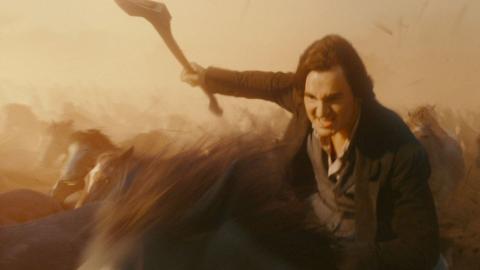
Apart from those unexplained phenomenom, I'd say this is a good film. Maybe not a great film, but definitely not deserving of the crap it's been getting. I reckon if people went to see this with a different mindset and not expect a cheeky riff on history, then they may enjoy it more. Not that it's historically accurate at all (Lincoln had three children, not one!), but that has never before stood in the way of a clever story. The best way I can describe this is a historical action movie, and if you remember that all action movies aren't piles of fun then sit back and enjoy an excellent escapist movie with good acting and vampires. What more could you want! Until next time, readers, where I promise it will be zombies!
Tuesday, 10 July 2012
The Woman in the Fifth: Book and Film
And I thought it would be easier to talk about this as an adaptation. Okay, it is slightly easier bit only a smidge. This has to have one the most confusing twists I have ever seen. M. Night Shyamalan has nothing on this story. And the rest of the film is pretty goddamn cryptic as well. It's arty in the purest sense of the word, as much as the book is pulpy in the dirtiest sense of the word. Every shot means something, every line has a double meaning. And after nearly a month since I first saw it, it still makes little sense. The book makes more sense, in parts. Mainly characters back stories.
The film stars Ethan Hawke as Tom Ricks, an American writer who travels to Paris to try and save his relationship with his French wife and young daughter. After every bad thing that could happen happens to Tom (his wife calls the cops on him, and he loses his luggage) he finds himself in the Turkish district of Paris, with only 10 euros to his name. He manages to find a disgusting and tiny room, and a job as a nightwatch-man for some shady figures (where he spends his time writing a letter to his daughter), and he lives a miserable existence for many weeks. Until he meets a mysterious woman named Margit (Kristen Scott Thomas) and they begin an affair. The film follows all the major plot points in the novel. There are a few differences, most of which I will go into later, but there are a few little ones that were changed so that things would fit better into the movie story line, like the age of Tom's daughter changes from 15 to 8, his wife isn't French and he was a teacher in America rather than a writer. There are also several characters compressed into one and they become Sezer (Samir Guesmi), Tom's landlord and boss.
If you want to go to Paris, don't read this book, and most definitely do not see this film. This shows the real, unglamourous Paris, the back streets of Paris. The setting is grey and dirty, which amplifies Tom's mood for most of the movie. Of course, it's sunny ... once, but only after something good happens to him. The rest of the time, the colour scheme is monochromatic blue. This is also enhances the unromantic nature of the movie. Even though the plot has two people who have an affair, it's more of a character study about Tom's complete breakdown after he loses everything he once had. We never find out what exactly caused his wife to leave him. In fact, we hardly find out anything. We don't know what is going on in the building where he does spends the majority of his nights. We only vaguely know what's going on with Margit, and this ambiguous nature is what makes the film more endearing. It stays in your head for so long after, that you come up with a lot of different scenarios as to what could've actually happened. It is also extremely refreshing to here an American actually speak French while in Paris. And I have to give big props to Ethan Hawke for managing to speak French for the majority of the film. Kristen Scott Thomas is also brilliantly elegant, but then again she always is.
So, I guess now we'd better get on to the adaptation, and I have to say that this actually very good. The director Pawel Pawlikowski knew that many things had to be changed in the transfer between book and screen, and the things that were changed were done so to enhance the characters. But there are a few things that were changed that didn't make sense, the main one being that in the book the main character is called Harry, not Tom. The only reson I can think of is that you don't pronounce H's in French but it's still an odd thing to change. There is one other thing that I want to talk in depth about, and that is that the book explains everything. And I mean everything! Harry's job, what happened to his marriage, what's up with Margit. All these elements that made the film intriguing (albeit more frustrating) in their vagueness are all neatly presented to us in a nice package. And it makes the book a lot less thought provoking (apart from that pesky twist).
So, if you were pulling my arm and forcing me to choose between the two, I'd actually say that the film is better than the book. And it comes down to the fact that the only thing that saves the book is the ending. I'm not saying that the rest of the book is bad, no it's fairly well written. But it's written like a pulp novel, and at times can be extremely monotonous. While it could be argued that the film is also rather monotonous, it has a darker, edgier atmosphere which comes fromnever knowing what's going on. Also, it is more of a character study so the long dragging scenes in Tom's office are all used to show just how far he has fallen. There are some similarities between the two, of course. The grey tone of the book is translated excellently and they both just sort of end without providing a solid ending.
All in all, it's one of the best adaptations I've seen. I mean it turned a pulpy romance novel into a serious art film. I'd recommend seeing the film before readong the book because the book really spoils all the mystery that film had. Though the film can be frustrating at times, so maybe if you prefer your stories more fleshed out, then you might be better with the book. It really comes down to personal preference. Well, this was an epic review, and a long time coming. Next up, possibly A Royal Affair. So, until next time readers.
Subscribe to:
Posts (Atom)


