Friday, 19 October 2012

I Wish


Now, I'm not an expert on Asian cinema. I've seen a few kung fu movies, a little anime movies, Studio Ghibli of course. But not really any drama or comedy movies. So, I can't do what every other reviewer has done when reviewing this film. I can't compare it to Hirokazu Kore-eda's previous film Nobody Knows. Besides, a film should be able to stand up by itself. So, what is this film? This is a very gentle film about two brothers. That's about it.


Koichi Oosako is a young boy who lives with his mother and grandparents in a small town that is shadowed by a still active volcano. It has been six months since his parents have separated and his younger brother Ryunosuke still lives with his musician father. When Koichi finds out that when the first two speeding bullet trains meet, a miracle will happen. He and his friends then hatch a scheme to be there when the trains pass and yell out their wishes so that Koichi can wish for his parents to get back together. He tells Ryu, and persuades him to come along and wish for the same thing. But Ryu has accepted what has happened, and doesn't know if that's what he wants to wish for anymore.


Since this is my first introduction to Kore-eda, I can't really comment on his style or anything, but I can say this. He seems to be a filmic version of Haruki Murakami, in that he makes the everyday seem magical and takes his time over the small things that people take for granted. And this film really is about the normal magic that Murakami higlights expertly, especially in his short stories. This is also very gentle, and is largely made up of subplots that each of the characters go through. Like one of Ryu's friends, a girl who wants to be an actor despite her mother disapproving. Or Koichi's grandfather who used to be a baker and is trying to recreate traditional karukan cakes. Everything is very small scale, made fantastical because it is shown through the eyes of children.

And the children are exceptional. For some reason, these past few months have had incredible child ensembles. And this is no different. There is a part of the film where they each talk about what they would wish for and it seems almost like a documentary, the acting is so natural. This is helped by the fact that Koichi and Ryu are played by the incredible Maeda brothers. And considering that they only share about 10 minutes of screen time together, the bond between them is awesome even if you don't know that they are brothers. And the fact that there are no 'bad guys' makes the adults of this kids world the only 'bad guys' that are here, and the kids outshine the adults so much.


Now, I want to talk about the ending briefly, because it can be interpreted in a few different ways. Well, two different ways. So, if you want to see the film without spoilers, stop reading now. If you don't mind spoilers, then go ahead and read. At the end, each of the kids shout out a wish, except Koichi, who finally accepts that his parents are never going to get back together and 'chooses the world' instead. Now, all the other wishes to me seemed like they came true, or at least some of them did. For me, at least. There are a few shots that seem to confirm this, but it's more implied than right out said. But I'd still like to believe that they came true, maybe not through any actual magic (though that is debateable) but through the kids own determination and persistence. Again, open to interpretation, but I'd like to think that they came true.

So, again, I am sorry that this took so long and that it's so rambling. But oh well, go see this film. It's lovely and gentle and very easy to watch. The thing that I didn't like about it was mainly that the subtitles didn't translate any text, so I have no idea what the place names are or anything. But that's the only complaint that I have. Hopefully, I'll get the next review, which will be Killing Them Softly, up in the next few days. And hopefully it will be better quality than this. But go see I Wish, it's adorable. Until next time, readers.

Sunday, 14 October 2012

On the Road


I'm amazed how often some actors get type-cast. Sometimes without them even knowing it. I am of course talking about the female Ben Affleck, Kristen Stewart (though that isn't really fair to Ben Affleck. Maybe he's just the male version of Kristen Stewart). For some reason, she always plays 'relatable' young women over whom two men are wanting to be with/ lusting over. And you'd think that this would be the movie to stop that, but no. This is an adaptation of the generation defining book by Jack Kerouac, which came out in 1957, and is based on a series of journeys that Kerouac undertook with his friend, Neal Cassidy, during the 1940s. It is also the most famous novel from the beatnik era, and has long since been thought to be unfilmable. I did read the book before seeing the film, and I can tell you right away the film does not compare.

The main plot follows a series of 5 trips that Sal Paradise takes across America, all involving his hero Dean Moriarty. Along the way, they interact with various recurring characters, including Carlo Marx, a young beat poet, Old Bull Lee and his wife, Jane, Mary Lou and Camille, two of Dean's wives.We get veiws into Dean's unorthodox home life, that paint him as a charming drifter with no concept of responsibility. All of the characters are based on people that Kerouac knew in real life; Sal is the fictional embodiment of Kerouac himself, Dean is Neal Cassidy, Carlo Marx is Allen Ginsberg and Old Bull Lee is William S. Burroughs. The film manages to stick as close to the books narrative, but sometimes that isn't necessarily a good thing, as we will see.


So, firstly, was there anything good in the movie? Well, yeah, is the short answer. The women were characterised well. In the books, the women are basically just attachments to the men and aren't given anything to do except have sex and get the marajuana ready. In the film, they are given characters! Actual real characters. And both Amy Adams and Kirsten Dunst are very good. Kristen Stewart is okay. And that really sums up the whole movie. This film exists. That is the nicest compliment that I can give it. It's just okay. Not terrible, but definitely not good. So, while it gains points for having good female characters, it loses them immediately for being dull.

Of course, the thing with the women will only come to light if you have read the book. Speaking of the book, I'm not the biggest fan of Kerouac. There were good parts, and the way it is written is beautiful. But there are parts that I didn't get, and if I read it again, I still probably wouldn't get it. The characters are quite selfish, especially Dean. And even though he has this charm that shines through the pages, there were some times when I just couldn't understand what Sal saw in him. And that was sort of the point. It was like Frankenstein to me. The author builds up this character so you expect him to be pretty amazing, but after you finish the book you just find him to be a dick. Amazingly, this didn't come out in the film.


I don't know what the filmmakers were trying to do, but they seemed to be trying to make Dean a 'nice guy'. Or at least sympathetic. In the book, we are shown Dean warts and all, and the strength comes from the fact that even though he is a completely selfish person, Sal still thinks of him as a great mind, and a great man despite what he did. Here, there is no charm, no charisma, just an actor trying to do what he thinks is Dean. And it doesn't work. By trying to make Dean a nice guy, you are trying to find excuses for the things that he does. It just can't be done. He's almost an anti-hero in the book (or at least he was to me. Don't take everything I say about the book as law, I'm not an expert) and in the film they try to make him a romantic lead.

So, the book remains unfilmable. Really, the best way and the only way to do the book justice is to not do a direct adaptation. Make it insane, make it crazy! Make it imaginative. You need to capture the essence of the book, not the story. In the end, the story isn't what matters, it's the way it's written and what it has to say. Give this one a miss. But do read the book, I may not understand it all that well, but it does need to be read. Sorry this took so long, and that it's so short. But guess who's been sick again! Anyway, next time should be the Japanese film I Wish. So, until next time readers.

Thursday, 4 October 2012

Beasts of the Southern Wild and Dreams of a Life


That's a long title for 2 fairly short reviews. But I'm doing these two together because they're kinda similar and it's been too long since I've seen both of them to leave this for any longer. So, before either fades in my memory any longer, let's get on with this. Beasts of the Southern Wild is Benh Zeitlin's debut film directing and first came out in Melbourne in this years MIFF. It has gotten amazing reviews and there is already Oscar buzz humming around it. Dreams of a Life also got good reviews, but unfortunately was only released in Australia on one screen (ACMI) and has now left the country altogether (I think). Both these films deal with the intense themes of life and death, while also looking at community and survival. So, maybe it's a good thing that I'm looking at both of them at the same time. Let's just hope my writers block eases up enough to get this review out.


Firstly, let's take a look at Beasts of the Southern Wild. Hushpuppy (Quvenzhané Wallis), a vivacious six year old, lives with her father, Wink (Dwight Henry) in a bayou in New Orleans known to those who live there as the Bathtub. The other people who live there are a tight knit collection of misfits, with little money who have to make do with what they can find and what they can kill. When a storm floods the community, those who remained behind are forced to make boats and find what they can before the water gets rotten. But the government services are vacating all areas that were affected bu the flood, whether they want to leave or don't. And Wink has also been keeping a secret from Hushpuppy, the fact that he is slowly dying.

If you couldn't tell, this is a movie that takes its time with the plot. Not a lot happens, yet it is in the little things that do happen that where the magic of the movie takes place. This has been called a fantasy film, and that mainly comes through the imagination of Hushpuppy, and the magic that she finds in everyday things. Throughout the movie, she constantly stops to pick things up so she can listen to their heart beat and know that they're alive. But this is not a kids movie, and the fantasy elements are matched by incredibly dark real moments of struggle and survival. Wink to some may seem like an irresponsible father, but what he is really doing is preparing her for the day that he leaves her, so he knows that she will be able to look after herself after he's gone. And that's what this film is really about. A community of outcasts trying to survive in a world that is slowly being destroyed.


The film has a little bit of an environmental message as well, but it's hidden behind incredible images that it really isn't that noticeable. The soundtrack is incredible, and I stayed until the end of the credits because it was so moving. But the most incredible thing about the movie were the two leads. Quvenzhané Wallis and Dwight Henry aren't professional actors and this is the first movie for both of them. In fact, Henry originally was the owner of a bakery across the street fromt the casting agency. He has lived through two hurricanes and his experience brought an added passion to the role. And as for Quvenzhané Wallis, the part was originally intended for a much older girl, but she wowed the filmmakers so much with her scream and her presence. Plus, the bond between both of them is one of the best documented father/daughter relationships onscreen. It's hard to believe that they aren't related.

So yeah, this film is worth it. And worth so much more than the brief paragraphs I give it. There was only one problem with it, and unfortunately it was a big one. The hand-held camera work made me so nauseous that for most of the film I had to have my eyes closed or else I was going to throw up in the cinema. This is a warning to all those who suffer from motion sickness, and it's a shame because I would love to see this film again. I just can't, because it will make me sick. But if you aren't phased by shaky cam, then go and see it before it disappears.


And now onto the second film, Dreams of a Life. This is a documentary from Carol Morely about the life and death of Joyce Vincent, a woman who died in a London flat and was only discovered 3 years later, lying on her sofa with the TV still on, Christmas presents scattered around her body. The only way she could be identified was through dental records as her body has pretty much melted into the floor. In order to make the film, Morely put ads saying 'Did you know Joyce Vincent?' in newspapers and on the sides of taxi cabs, so that people who knew her, no matter how vaguely, could come and talk about Jouce and what she was like during her life.

This is an odd and sad story. How can someone just be forgotten for 3 years? Why didn't the neighbours come when a strange smell started to seep through? And most importantly, how did she die? None of these questions are answered, and if you like documentaries resolve the issues they present, then this isn't for you. From the interviews, we never get a clear idea of who Joyce is, and in that way the message is very heavy handed. But the other questions that it doesn't focus on are the more interesting. So, I didn't come away from this thinking 'How well do you ever really know someone?' I came away from this thinking 'How can someone just disappear?'


A lot of the film is taken up with reenactments, featuring actress Zawe Ashton as Joyce, and she does an excellent job. But they take up so much time in the movie that they feel like padding at times. They also made Joyce feel more like a character than a real person, but there was so little information from the interviews at times, that the reenacments were needed. But again, in the end I do applaude this movie. It took a woman who was famous for her death and gave her a life (however cliched that sounds, it's true). It took what was essentially a sensational tabloid story and created something real. So, while nothing is resolved, while some things may make you frustrated, this is an excellent documentary and is incredibly different and moving.

Well, that's that done. Dreams of a Life sadly has left our shores now, unless Nova has decided to show it. I hope that it comes out soon on DVD, because it is such a startling story, about how a woman became so desperate that she had to cut herself off from her firends and family and lives in what is essentially squallor. We don't know how she came to be there, we don't know whether she committed suicide. However, what we do know is that she did live, and she did manage to touch so many lives. I'm doing a classic mistake of adding information during the conclusion, so I'll stop now. Anyway, hopefully I will get my next review up before the end of the week. Until next time, readers.

Friday, 28 September 2012

Monsieur Lazhar


I like the trailer for this movie, because it doesn't give anything about the film away. I mean what the film is really about. All the trailer presents is a To Sir With Love type romp except set in Canada and in a primary school. Which, while it kinda is, it's a lot deeper than To Sir With Love, and raises a lot of issues, that if you just saw the trailer you wouldn't have picked up on. And of course, if you haven't seen the film, I will now spoil any surprise that was held for you!

When a primary school teacher hangs herself in her classroom, the school is thrown into chaos. The teachers are unsure how to help the children with the grief while also struggling to cope themselves. The principal (Danielle Proulx) is also having trouble finding a replacement for Martine, until Algerian Bachir Lazhar (Fellag) turns up and offers his services as a teacher after seeing the suicide in the paper. With no other option, he is hired right away. Gradually, we see how the children adapt to the new teacher, and how he bonds with them and helps them with his grief. Along the way, we learn about his violent past, while he is opposed by the other teachers and some of the parents who find objections in his rather old fashioned way of teaching.


This is a very satisfying film, and I don't mean that it is competently made with very little else to it. No, there is plenty to this film. So many issues ar available to be looked at and talked abou, but almost all of them are left unanswered. This is the main problem with the film. Yeah, I'm starting with the problem rather than the good stuff, but there is a lot of good stuff. So, for discussions this is a good movie. It will leave you thinking about it for a long time afterwards. And also brings forth a lot of themes for critics to cite and drone on about. Which is what I will do, though I can't offer any real resolutions. How perfect for an ex-Lit student.

So, the main thing I got from this film was the difference between the adults and the kids. I know it sems like a weird thing to hone in on, but for me it was the most important part. The adults are so scared that they will traumatise the kids if they talk about Martine's death, that they never confront it except with a school psychologist who makes visits once a week to every class to check on the kids for a few months after the suicide. Lazhar actually tries to talk his class about it on several occaisions, but every time he is then reprimanded by the principal. The way chilren are treated in this movie is like atomic-bombs, all the teachers are too frightened of lawsuits to make sure that they are fully okay. One of the best quotes from the movie is from one of the students, "They think we are traumatised, but they are more traumatised than us."


The film is also about violence, though it is not a violent film. The act that Martine commits, the way one of the students, Simon (Émilien Néron) gradually becomes more and more violent to his fellow classmates because of the guilt he feels. Even Lazhar's himself comes from an extremely violent background. His family is taken from him in such a tragic way, and it is through this that he is able to connect with the students and understand their pain. My favourite scene is when Alice (Sophie Nélisse), another student, presents a speech about violence to the class, and expresses her doubts about Martine, and questions why she would kill herself in a classroom. It is the most powerful part of the film. Alice doesn't break down and cry, doesn't even shed a tear. Just presents her speech formally and honestly, then sits back down again.

This brings us nicely to the acting. The two main child actors, Émilien Néron and Sophie Nélisse, are two of the best child actors I have seen in too long a time. They outshine their adult co-stars so brightly (scuse the pun), and they are so real with their reactions. Fellag is also excellent as Lazhar, who's intentions and approaches to teaching clash with what the kids are used to , and the modern curriculum. But the kids are really the stars here. It's so refreshing to see something other than the Disney-esque cutesy stuff we normally get. And considering the subject matter, they all do exceedingly well to convey the complex emotions that normal people go through when something like this happens.

 
This review doesn't really express how incredible this film is, but then again, no review ever can. It was Canada's entry for Best Foreign Language film at the Oscars, and actually made the short-list. But awards shouldn't be what makes you go see a certain movie. I hate the word heartfelt, but that is what this film is while I try and think of a better adjective. It's emotional yes, and a little sentimental, but done in a naturalistic way that isn't exactly meant to inspire, simply meant to show us a moment in a mans life. I'm sorry this is incredibly rambling, and that it took so long to come out. I am now proudly two weeks behind schedule, but I will try and get the next review, which should be Beasts of the Southern Wild, within the next ... whenever. Until next time, readers. Those school-girl days....

Friday, 21 September 2012

Murder by Death vs. Clue: The Movie


I love murder mysteries! You could call them my guilty pleasure if you wanted to. There's nothing I'd rather do than to watch Midsomer Murders and point out all of it's plot points! And I'd rank Agatha Christie as one of my favourite authors, with both Death on the Nile and And Then There Were None as two of the most entertaining and excellent books I have ever read. On and off over the years I have watched various BBC TV detective shows, like Foyle's War and The Gil Mayo Mysteries (which is probably one of the most underrated shows ever to be produced) but there are fairly few movies, especially nowadays, that give a serious mystery any more. These two aren't serious mysteries, both gloriously parodying the murder mystery genre.

So, if you hadn't guessed, I will be talking and comparing two movies that are both very similar, in their general plot and yet quite different in their execution. And they also have become cult movies and have all but been forgotten by modern audiences. I am of course talking about the 1976 film Murder by Death, and the 1985 film Clue, based on the popular board game. The main plots for both are almost identical. A group of strangers/aquaintances find themselves summoned to a remote country house by a mysterious host for an unkown reason. The main difference in the plot is that the guests in Clue don't know each other, but are all being blackmailed by the same person. The guests in Murder by Death are all parodies of famous literary detectives, like Poirot, Miss Marple and Charlie Chan, and they are brought together to determine which one of them is the best. Tim Curry, Leslie Ann Warren, Madeline Kahn and Christopher Lloyd star in Clue, while Maggie Smith, Peter Sellers, Peter Falk and Truman Capote star in Murder by Death. Eileen Brennan amazingly stars in both.


So, I'll be honest, the only reason I bought Murder by Death was because Truman Capote was in it. I mean, IT'S GOT TRUMAN FUCKING CAPOTE!! What more can I say? He's bloddy brilliant! Why wouldn't I want to see a movie with him in. Why wouldn't anyone not want to see a movie with Truman Capote. With Clue, it was more a matter of needing one final DVD to borrow and thinking "Why not?" So, this will be a a versus type thing, mainly because it's easier to write it that way, but also because it would be interesting to see which one is the better mystery. Which I won't spoil. Cause you should see both films. Right now. 

Let's start by looking at the characters. All of them, in both films are completely insane and over the top. What is really good, especially in Clue, is that given the massive ensembles, there manages to be distinct characters, though there are some actors that steal every scene they are in. Capote one of them (and you thought I'd stopped going on about him!), and he has the least scenes out of anyone in both films. Others include Madeline Kahn from Clue, who ad-libs hilariously throughout, and Maggie Smith from Murder by Death, who has the best line in the film. Individually, Clue is less of an ensemble movie and more like Tim Curry and friends. Curry gets the best gags and the most exposition, the others never really get out of being guests. What I do like about Clue though, is that none of the characters are what you are expected from playing the board game, and each of them stay within their character. Which is kind of bad, because they become cliches of themselves.


With Murder by Death, the interesting thing is that each of the characters are based on famous detectives, or detective-y tropes. Like, there is a Poirot, Milos Perrier (James Coco) who is very childish, eats too much and obssesses over his appearance. Peter Falk plays Sam Diamond, who is based on those film noir detectives in old American movies, and he speaks out of the corner of his mouth and never speaks in anything but depressing, cryptic sentences. The others are similarly exaggerated fictional detectives. But I'd say that Clue has the better characters, because it is easier to establish their character tropes and identify with them. Also, in order to fully appreciate the humour in Murder by Death, you need to know who is being parodied. Otherwise, Peter Sellers' Charlie Chan will leave you feeling very uncomfortable. It's worse than Mickey Rooney in Breakfast at Tiffany's.

Well, what about the setting? What I like about both movies is that they are set in old, beautiful, kinda creepy mansions, and (especially in Murder by Death) the houses become characters in their own right. You might be thinking that they are quite similar, but you'd be wrong! The setting for Clue is fairly well-known, and so the creators had to try and remain faithful to the board game when they were writing and designing the film. But there are times when I couldn't tell the difference between the lounge and the study (a nitpick, I know, but oh well), and some of the rooms, like the ballroom, conservatory and billiard room, had to be shoe horned in since they didn't really have anything to do with what was going on. The mansion in Murder by Death, on the other hand, is pretty incredible. Capote's Lionel Twain is a mad inventor, with a machine to make it look like it's raining whilst it's not, and a room that collapses in on itself. It's geniusly insane! So, for this round, Murder by Death gets the point.


I suppose there's nothing left to talk about except the most important part, the mystery. I will say, if you're open to silliness both films should have satisfying endings. I'll say first up that Clue has the more accessible ending, and is probably the one that more people will like. Murder by Death is a lot more complicated and your enjoyment of depends on whether or not you liked the ending to Monty Python and the Holy Grail, since they are quite similar in not fully resolving anything. But I'll go into a bit more detail after I talk some more about Clue.

Clue starts like an Agatha Christie-esque mystery, where someone is killed in the middle of a room full of people, causing all the guests to be suspicious and hysterical. Then it just gets silly. I don't think I'm spoiling anything when I say that anyone who isn't a playable character or Tim Curry is killed in some form or another, handily using all of the weapons that are readily available because the host was rather stupid. And right at the end, four people die in such a quick succession that the film ascends to a ridiculous level of silliness. However, to fit in with the board game there are 3 possible endings, that were distributed between different cinemas on it's original release (and if you get the DVD, you can choose whether or not you want to watch a random ending, or all 3). But for a couple of the endings,  when they try and fit the deaths to the murderers, it becomes extrememly convoluted. If you go get the DVD, then watch the VHS ending, which is a lot more satisfying and shows all 3 endings one after the other. In the end though, this is meant to be a comedy so the energetic ridiculousness of it all fits in nicely with the rest of the slapstick that fills the film.


So, now we get to the more complicated and insane ending of Murder by Death. In all honesty, by the time you finish this, you don't know whether or not a murder was even committed. The big problem with this film is that the plot is fairly non-existence, but the dialogue is very witty and is what saves the movie from being terrible. I will say this though, if you hate murder mysteries or detective novels, then you may like this. It parodies and satires the genres so well, and points out all the flaws of the most famous literary detectives and shamelessly humiliates them. It is brilliant, even more so if you know who the characters are. But what about the mystery itself? I've seen this about 3 times and I'm still not sure exactly what happened, but I think that's the point. You aren't meant to understand, and in the end this was just meant to be a glorious parody and hopefully provide a few laughs along the way. It is a little frustrating when you reach the end though, but as I said, if you can stand the ending to Holy Grail, then it may not annoy you as much.

So, which one wins? Does one have to win? Well, the one I prefer is going to be winner, cause I'm selfish like that. But I wouldn't put either above the other, they're too similar for that. And yet, the differences that they have each make them enjoyable. Clue is probably the one that the majority of people will enjoy, since it is more 'mainstream' (whatever the fuck that means) and more accessible for people. Murder by Death is more surreal, and while both end up spoofing the genre in very different ways, I like Murder by Death better. Clue is a lot more of a traditional parody, but you will never see anything like Murder by Death, and so it's my personal winner. If I've sparked your interest at all, find these two and check them out! I'm sorry this took so long to get out, but I was sick... and lazy. Next time, hopefully it will Monsieur Lazhar, and hopefully it won't take so long to get out. Until next time readers, don't be tacky.

Tuesday, 11 September 2012

Moonrise Kingdom

 
I hate the word "indie". To me, it doesn't really mean anything and it associates itself with people who think they have better taste because they like things that are slightly more obscure than mainstream. To me it is a derrogative term, so I won't call this film indie. Instead I will say it is original. Well, only if you haven't seen a Wes Anderson film before. I didn't really know how else to start this one. I could talk about the director, but I already did that in my Bernie and Trishna reviews, and I do so hate repetition. Also, in talking about Anderson's other works I'll just end up comparing this one to them, which every other reviewer is doing and I hate cliches as well.  Well, I could go straight into the plot, but then that would break up the loose structure that I normally use. Naming the film, and the director, seems a little redundant now, since if you've read this far then you know those facts already. If you know anything about the film then you probably know the basic plot already, but I will go on with a brief synopsis in the next paragraph, as I think this shameful introduction has run its course.


12 year-olds Sam Shakusky (Jared Gilman) and Suzy Bishop (Kara Hayward) are two outcasts living on the (fictional) island New Penzance, off the coast of New England. Over the course of a year, they correspond secretly and run away together during summer, much to the concern of Suzy's lawyer parents Walt (Bill Murray) and Laura (Frances McDormand) and Sam's scoutmaster Ward (Edward Norton). The two kids enjoy a couple of days of complete bliss away from the adults that run their world, while the Bishop's, Ward and the island's policeman, Captain Sharp (Bruce Willis), are desperately trying to find them. What plays out is a story about finding love and a place where you're happy as seen through the eyes of two children, an exaggerated truth about chilhood during a time when parents were finding it hard to connect with their children.


So, I have a problem with this film, and I don't really know how to talk about it (you might've guessed that from the introduction). Partly, I think it's just writers block, but I really don't know what to say about this film. Which is odd, because I really liked it. I liked it so much that I am seriously considering putting it on my end of year best of list (yes, that will be done). It is a really good movie, and one of Anderson's best. But, again, I can't find the words to describe it. I suppose I shal have to be boring and just say why I liked the film instead of giving a semi-deep analytical view. Well, I do like the premise. Two twelve year-olds who fall in love like adults, it is very different and one of the best premises I've heard since Harold and Maude. I like the way the adults of the film are portrayed like kids, particularly Edward Norton' Scoutmaster Ward, who seems to lead an unfulfilling adult life, so he spends his free time being an almost dictatorial leader for a group of kids, and instead lives his life to a strict regime with needed to be broken up by the main characters escape. If you hadn't guessed, Ward is my favourite character.

The other adult characters all have something missing in their life, and while some of them aren't neatly fixed by the end, you do get the idea that they will try to do better with their lives after this event. So, what else did I like? The trademark Wes Anderson panning shots are always refreshing to watch, and I am once again aware at how well timed they all are. And of course the minutest detail is carefully planned out. I particularly love all the books that Suzy reads out, with each cover designed by a different illustrator. I also like the way it's directed, with both children showing dead-pan emotion most of the time, while the adults run around almost hysterical at their absence. Of course, my heart is warmed by the scout boys who come to Suzy and Sam's rescue, even though before Sam was incredibly unpopular and didn't get along with the rest of the boys. I suppose it just shows that some things, like outcasts and bullying, are always going to be around, hence why we get so many coming-of-age stories.


The acting is excellent, with very underrated performances from the kids, and the adults nearly overacting. I have to highlight Jared Gilman and Kara Hayward as Suzy and Sam, who really excel and I can't wait to see them in something else. I already said that I liked Edward Norton (like is too weka word, madly in love is more appropriate), and Tilda Swinton as Child Services is also quite fantastic given the little that she does. But I think the best is definitely Bruce Willis, playing against his "die hard" action star character. If you've seen Death Becomes Her, then you may guess what he may be like. I also really like the colours of the world that Anderson creates. His palette is very much based on muted primary colours, again enhancing that child-like quality.

Well, I've managed to write about something. I suppose I'd better say what I got from the film, and maybe that will uncover why I find this film so hard to write about. Well, the main thing I got out of the film was a sense of longing for the past. Let me explain. For a few short day, Sam and Suzy spend time together being able to be whoever they want without judgement, and from that a love grows. After such a short amount of time, they are dragged back to reality, and both of them seem to know that while things will never be the same, they will never have the time they had during this one summer ever again. And at the end of the movie, you feel that there is overwhelming sadness between the two kids that they will never live those days again. It makes this film sad, and to add to the sadness the mournful music of Benjamin Britten, whose compositions for children litter the film and add a personal touch from Anderson, who grew up with that music.


So, why did I find this film so hard to write about? Well, if you recall, I said I had a problem with it, and that is that while it is incredibly entertaining to watch while you're watching, it doesn't leave as great an impact when you leave the cinema. It's hard to explain why, and it's not as if it leaves you with nothing to think about, but it leaves you wanting something that it didn't give you. And with a rather sad ending to boot, this falls a little in my love for it. I still think this is an exceptional film, and one that really should be seen. I am sorry if this review turned out to be a little existential, but writers block is a terrible burden to bear. Also, I don't want to spoil for those of you who haven't seen it yet, so I kinda mentally blocked some things while writing. So, yeah. Nothing more to say, really. Until next time, readers.

Tuesday, 4 September 2012

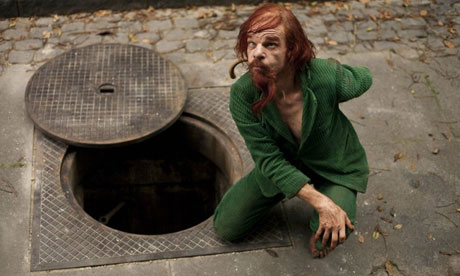
Holy Motors


... Um... Er... Uh......... Merde. Ben, je pouvais ecriver la revue en francais, mais I really can't be bothered and I've pretty much exhausted whatever high school French I had left in me. If you hadn't guessed, this is a French film from director Leos Carax and I have no idea where to begin with this one. I mean it. On the poster it says "One of the most original films of the century", and I'm very inclined to agree. I don't think anything like this will ever come again. The only way I can describe watching it is like watching a Jean-Pierre Jeunet film on acid whilst being repeatedly hit over the head with the Beatles' "Revolution No. 9". Your head hurts after and you have no idea what you just say through.  

Holy Motors follows one day in the life of M. Oscar (Denis Lavant) as he is chauffered around Paris in a white limousine by his driver Celine (Edith Scob). We see him going to his different appointments during the day and way into the night. The appointments are tied together through the conversations and interactions of M. Oscar and Celine as they drive to the next appointment. Because of that, it feels like lots of little short vignettes joined together loosely forming one incoherent whole. Though it soon becomes clear that Oscar's busy schedule is draining him and he is slowly loosing his will to carry on. Some of his appointments include kidnapping a doll-like model (Eva Mendes), going into a motion-capture room, picking up his 'daughter' and playing a dying uncle with another associate.


Since I have nowhere else to start, I will begin with the acting. I haven't seen Denis Lavant in anything before, though I know that he has been in all but one of Carax's films previous to this one. This has to be the best performance of the year. Lavant doesn't just play Oscar playing other characters, he plays 11 different, fully fleshed characters (or as fully fleshed as they can be given the time) and yet is still able to show us that he is slowly losing himself with every new role that he takes on, and it becomes apparent that he is living his life through other people. He has been doing his job (which is never fully explained) for so long that he is starting to lose not only his motivation, but whatever part of himself is left. The other actors are good, especially Edith Scob as Celine, Eva Mendes as Kay M and rather surprisingly Kylie Minogue as a former aquaintance/lover of Oscar's.

Visually, this looks pretty amazing. Paris looks fabulous at night, and we see some back streets and landmarks that you don't usually see when someone films in Paris. But the cinematography is especially great in the motion-capture scene as it shifts between normal and slow motion so seemlessly. The music is also good, when it's there, as the film mainly uses a natural soundtrack, and every song used is used for a specific purpose (though I do guarantee that Kylie Minogue's song will get stuck in you head for ages after). In fact, my favourite part of the film might well be the intermission because of the great accordion break down!


But that's the thing with this film. Because of the vignettey style it's hard to look at this as a whole, at least for me it is. I'm not going to pretend for a minute that I know what this film is trying to say, like some other critics have, littering their reviews with stupid phrases like "I can't tell you what is going on because then it would spoil your viewing of it". I don't know what is going on (well, I do in a story sense, but not a thematic sense), but instead I will give two theories that may be right, but probably aren't, in order to shed some light on the film.

The first is what I thought while watching the film in the cinema, and that is that all these appointments are for an unseen audience that can only experience life through those who work for the company Holy Motors, those like Oscar. This come through the opening scene of a cinema audience watching a movie (and I will say that it is very disconcerting to watch an audience watching you watching them... try and put your head around that one), and also through a conversation with Oscar's boss, who says that he is losing his touch, obviously referring to his acting. Also, Oscar is portrayed as a never dying being, who seems to be put through these bizarre scenarios for someones perverse pleasure. And some of them really are perverted, especially the one with Eva Mendes as supermodel Kay M, who is kidnapped by a disgusting sewer creature.


The other theory, which was brought forward during my film groups discussion, is that this could all be a dream. And it really could be. This is a very surreal film, with none of the parts connecting except for oscar, yet each part tells a distinct story in itself. The dream theory is very probable and not just a way of admitting that I don't really know what it all means (I already told you that). For what if Oscar was having trouble at work, it might explain his stabbing scene. Or what if he's having trouble communicating with his daughter, that would explain her scene in the car. Or what if, a million other what ifs! I'm inclined to believe the dream theory, along with Carax himself has said about the film.

Leos Carax is behaving a little like David Lynch in that he isn't explaining anything about the movie, and when he does they are pretty cryptic. But he did say something that caught my attention: "You could say that Monsieur Oscar (played by Denis Lavant) is an actor, but it’s not a film about actors. It’s a film about a man and an experience: the experience of being alive. I used the fact that he might be a actor or a kind of actor that no one is watching: a little like all of us." While it doesn't really tell us that much more, to me it gives the film more of an autobiographical feel. Like he was trying to recreate scenes from his own life that he wished could've gone better, while also putting these surreal fantasies in there as well, that were maybe drawn from dreams he had. This is enforced by a number of things; the fact that he has a cameo as a man who finds a secret door that leads to a movie theatre, and that Oscar and one of his alias', Alex, is an anagram of Leos Carax. And if this is just a mad dream that Carax is having, then it explains all of the references to other movies that you can find in this.


Oh yeah, there are references to other movies in this. But you may not get them, I only got one. The good thing is it doesn't mean that you lose anything if you don't get them. This is a critics movie, so if you find that if you go and see it and get annoyed at reviews for calling it a masterpiece when to you it is a just mess, don't worry. This seems to be the Eyes Wide Shut of Cannes this year, but executed way better and not nearly as frustrating. Would I recommend this? Well, no, unless you were wanting to see it anyway. If you want to see it then do, I'll bet you won't have seen anything like it. But if this doesn't sound like your kind of thing, then it probably isn't. I'm still not sure if I actually like this. As I said before, there are parts I like, but as a whole I'm incredibly ambivalent. It would probably benefit from repeat veiwings, so I may borrow it when it comes out. I will say this for it though, it was so much better than Cosmopolis. Until next time, readers, in which we enter the indie circuit.