Showing posts with label cannes. Show all posts
Tuesday, 4 September 2012
Holy Motors
... Um... Er... Uh......... Merde. Ben, je pouvais ecriver la revue en francais, mais I really can't be bothered and I've pretty much exhausted whatever high school French I had left in me. If you hadn't guessed, this is a French film from director Leos Carax and I have no idea where to begin with this one. I mean it. On the poster it says "One of the most original films of the century", and I'm very inclined to agree. I don't think anything like this will ever come again. The only way I can describe watching it is like watching a Jean-Pierre Jeunet film on acid whilst being repeatedly hit over the head with the Beatles' "Revolution No. 9". Your head hurts after and you have no idea what you just say through.
Holy Motors follows one day in the life of M. Oscar (Denis Lavant) as he is chauffered around Paris in a white limousine by his driver Celine (Edith Scob). We see him going to his different appointments during the day and way into the night. The appointments are tied together through the conversations and interactions of M. Oscar and Celine as they drive to the next appointment. Because of that, it feels like lots of little short vignettes joined together loosely forming one incoherent whole. Though it soon becomes clear that Oscar's busy schedule is draining him and he is slowly loosing his will to carry on. Some of his appointments include kidnapping a doll-like model (Eva Mendes), going into a motion-capture room, picking up his 'daughter' and playing a dying uncle with another associate.
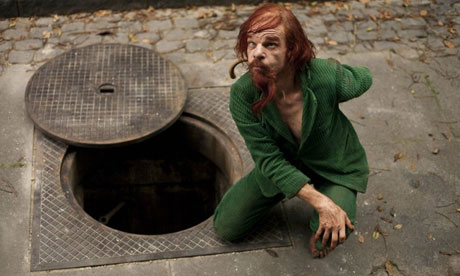
Since I have nowhere else to start, I will begin with the acting. I haven't seen Denis Lavant in anything before, though I know that he has been in all but one of Carax's films previous to this one. This has to be the best performance of the year. Lavant doesn't just play Oscar playing other characters, he plays 11 different, fully fleshed characters (or as fully fleshed as they can be given the time) and yet is still able to show us that he is slowly losing himself with every new role that he takes on, and it becomes apparent that he is living his life through other people. He has been doing his job (which is never fully explained) for so long that he is starting to lose not only his motivation, but whatever part of himself is left. The other actors are good, especially Edith Scob as Celine, Eva Mendes as Kay M and rather surprisingly Kylie Minogue as a former aquaintance/lover of Oscar's.
Visually, this looks pretty amazing. Paris looks fabulous at night, and we see some back streets and landmarks that you don't usually see when someone films in Paris. But the cinematography is especially great in the motion-capture scene as it shifts between normal and slow motion so seemlessly. The music is also good, when it's there, as the film mainly uses a natural soundtrack, and every song used is used for a specific purpose (though I do guarantee that Kylie Minogue's song will get stuck in you head for ages after). In fact, my favourite part of the film might well be the intermission because of the great accordion break down!
But that's the thing with this film. Because of the vignettey style it's hard to look at this as a whole, at least for me it is. I'm not going to pretend for a minute that I know what this film is trying to say, like some other critics have, littering their reviews with stupid phrases like "I can't tell you what is going on because then it would spoil your viewing of it". I don't know what is going on (well, I do in a story sense, but not a thematic sense), but instead I will give two theories that may be right, but probably aren't, in order to shed some light on the film.
The first is what I thought while watching the film in the cinema, and that is that all these appointments are for an unseen audience that can only experience life through those who work for the company Holy Motors, those like Oscar. This come through the opening scene of a cinema audience watching a movie (and I will say that it is very disconcerting to watch an audience watching you watching them... try and put your head around that one), and also through a conversation with Oscar's boss, who says that he is losing his touch, obviously referring to his acting. Also, Oscar is portrayed as a never dying being, who seems to be put through these bizarre scenarios for someones perverse pleasure. And some of them really are perverted, especially the one with Eva Mendes as supermodel Kay M, who is kidnapped by a disgusting sewer creature.
The other theory, which was brought forward during my film groups discussion, is that this could all be a dream. And it really could be. This is a very surreal film, with none of the parts connecting except for oscar, yet each part tells a distinct story in itself. The dream theory is very probable and not just a way of admitting that I don't really know what it all means (I already told you that). For what if Oscar was having trouble at work, it might explain his stabbing scene. Or what if he's having trouble communicating with his daughter, that would explain her scene in the car. Or what if, a million other what ifs! I'm inclined to believe the dream theory, along with Carax himself has said about the film.
Leos Carax is behaving a little like David Lynch in that he isn't explaining anything about the movie, and when he does they are pretty cryptic. But he did say something that caught my attention: "You could say that Monsieur Oscar (played by Denis Lavant) is an actor, but it’s not a film about actors. It’s a film about a man and an experience: the experience of being alive. I used the fact that he might be a actor or a kind of actor that no one is watching: a little like all of us." While it doesn't really tell us that much more, to me it gives the film more of an autobiographical feel. Like he was trying to recreate scenes from his own life that he wished could've gone better, while also putting these surreal fantasies in there as well, that were maybe drawn from dreams he had. This is enforced by a number of things; the fact that he has a cameo as a man who finds a secret door that leads to a movie theatre, and that Oscar and one of his alias', Alex, is an anagram of Leos Carax. And if this is just a mad dream that Carax is having, then it explains all of the references to other movies that you can find in this.
Oh yeah, there are references to other movies in this. But you may not get them, I only got one. The good thing is it doesn't mean that you lose anything if you don't get them. This is a critics movie, so if you find that if you go and see it and get annoyed at reviews for calling it a masterpiece when to you it is a just mess, don't worry. This seems to be the Eyes Wide Shut of Cannes this year, but executed way better and not nearly as frustrating. Would I recommend this? Well, no, unless you were wanting to see it anyway. If you want to see it then do, I'll bet you won't have seen anything like it. But if this doesn't sound like your kind of thing, then it probably isn't. I'm still not sure if I actually like this. As I said before, there are parts I like, but as a whole I'm incredibly ambivalent. It would probably benefit from repeat veiwings, so I may borrow it when it comes out. I will say this for it though, it was so much better than Cosmopolis. Until next time, readers, in which we enter the indie circuit.
Wednesday, 13 June 2012
Once Upon a Time in Anatolia
Oh God, where do I being with this? This has to be one of the most visually beautiful, stunningly deep, and down right gorgeous films I have ever seen. There is so much here to talk about, so many themes, so many shots that will stay in my mind for a long time after I've seen this. But this poses a conumdrum. For you see, I could tell you everything about this film that captured me, but this is one of those films that you really have to experience and discover for yourself. So, I'm going to give the things that stood out for me personally, and just hope that you go out and watch it, and come up with your own conclusions.
So, the basic plot is a group of police officers, including the Chief of Police for one of the big villages, a Prosecutor and a Doctor who have been brought in from out of Anatolia, and two Suspects, who travel around the countryside of Anatolia looking for a body. But it's not about that, not really. It's about the different characters, and how they strangely bond over this "quest", and how they respond to what happens over the course of the night. But, again, it's not just about that. It's about everything that isn't said, the silence in pauses, the looks between people. It's about what makes people human, what makes them monsters and everything in between. Director Nuri Bilge Ceylan has said that he prefers to not use words, because a lot more is said in silences, so the dialogue is minimal and is never really about the main plot. In a nutshell, it's deep. It's fucking deep.
I'm not really going to sell this film if I say there is a lot of standing around, looking at scenery and talking. This is like a murder mystery after the mystery has been solved. But, oh! The scenery is beautiful! Ceylan is a photographer as well as a director, if you pause any moment of the film you could sell the frame as a photo. The third shot of the film is two cars and a police truck driving along the winding Anatolian roads while the sun is setting, and it has to be one of the most amazing things I have ever seen, in film and otherwise. The lighting is incredible as well. The first half of the film takes place during the night and the only lights that are used are the headlights of the three vehicles and the "moon". Yet, with this minimal lighting it's amazing what you can see. The darkness is almost this mystical protector, and indeed when daylight does come, the characters become actual people rather than the half hidden hunters that they were during the night.
Instead of talking about all the big themes in this film, I'm just going to talk about the one that stood out the most for me. As I said earlier, there is a lot in this film, and you could come up with any number of things that I never picked up on. But for me, there was this overwhelming theme of guilt. A lot of the characters seemed to have this nagging guilt that they just couldn't leave behind and would interfere with the work they were sent to accomplish. There's Kenan (Fırat Tanış), the Suspect, who is haunted by the friend that he killed. The Chief of police, Commissar Naci (Yılmaz Erdoğan) who is never there for his son and beginning to feel the repercussions of that neglect. The Prosecutor (Taner Birsel), who's story I won't spoil because it's one of the greatest (for lack of a better word) twists of the movie. Even the mysterious Doctor Cemal (Muhammet Uzuner) and Chauffer Arap Ali (Ahmet Mümtaz Taylan) have hints of guilt or regret in what little of their back stories is revealed. Again, I already fear I'm saying too much, and I don't want to spoil the film but the guilt of the characters for me is what fills every frame.
And I haven't even got onto the acting! I'm not sure I should reveal anthing more about the characters, I do feel it is better going into any film and not really knowing what it's about. What I will say is that there is a forced sense of formality that doesn't truly disappear over the course of the film. And that there is a really dark wit to the writing at times. I'm serious, there are some laugh out loud moments in here. The acting felt a little wooden at the beginning but that might just've been the different cultures and a different acting style to waht I'm normally used to, and after a while you don't notice it.
I'm not going to pretend that this is a film for everyone. As much as I implore you to watch it, many of you won't and even if you all did, I'm sure there would be many of you that wouldn't like it. This is not a Hollywood movie, this is about as un-Hollywood as you can possibly get. There are lots of silences, and lots of darkness. There isn't any soundtrack, and except for natural noises, there is only one time when there is music. And it is long. Apparently 150 hours of footage was shot, and that was cut down to 157 minutes. The pace of the film is very slow and steady, so by the third act it does start to drag. But I don't care. By the time third act arrived for me, I was so engrossed with this movie that I had to see how it would finish, even though I did feel the drag.
Keeping with the un-Hollywood feel of it all, nothing is fully explained or finished. It is ambiguous, but in a good way. In a way that sticks in your mind for ages after and makes you think what actually happened. A lot of the main "action" happens off screen, making it even more ambiguous and confusing. This could be very annoying for some people who like their endings nice and neat. But I do have to say that the atmosphere is truly exceptional. I felt cold in the cinema, it felt like I was personally part of it and freezing my arse off in the cold Anatolian night.
What more can I say? I love this film. It's one of the best films I've seen this year, if not the best, so far. All I can say now is if I've sparked your interest in any way, please go and see this film on the big screen. It's one of the only film I've seen in years that really seems to understand that film is a visual medium. All I'm doing now is repeating myself. So, I'd better stop before you get bored. Until next time, dear readers. Until next time.
Wednesday, 2 May 2012
Footnote
Hello, and welcome again to more CAE movies, the best of the arty, bizarre and underappreciated. To start this term, we are looking at Cannes favourite Israeli film, Footnote, directed by Joseph Cedar. The story is exceptionally simple. A father, Prof. Eliezer Shkolnik (played by Shlomo Bar Aba), who has spent his entire life researching and teaching at the Talmudic Research department of the Hebrew University of Jerusalem, finally gets told that he will be given the Israel Prize after trying to get it for nearly 20 years. The only problem is that it was really meant for more popular and successful his son, Prof. Uriel Shkolnik (Lior Ashkenazi), who is also a Talmudic professor. What plays out in the film is a power struggle, a battle if you will, plays out between the father and son, and on many other levels, including generational misunderstandings and arguments between different methods of academic research. There is even a subplot about the social hierarchy of the university, shown with Eliezer's rival, Prof. Yehuda Grossman (Micah Lewensohn).
This film reminds me mostly of Shame, in the fact that a lot of what happens isn't fully explained and left up to audience interpretation. The director (thankfully!) is aware of this, and if you look up any interview with him about this film, he can give you his opinions on certain aspects. But this is my take on some of the thematic elements of the film. (I know that's just a roundabout way to get the analysis, but seriously, Joseph Cedar is one smart dude, and it's nice to hear a director explain what he wanted to do with his film rather than just say 'Interpret it yourself!'). The best way to sum up what is going on underneath all the layers of the film is to quote the director quoting Henry Kissinger: "The reason academic politics are so bitter, is that there is so little at stake." This is clear through the fact that there are three characters (Eliezer, Uriel and Grossman) who all study the same thing, "different versions and phrasings of the Jerusalem Talmud" (thank you Wikipedia!) and the competition and bitterness between the three of them is clear throughout the film.
The father and son battle at the centre of the film is, for lack of a better word, sad. This is the only film I've seen where the two main characters never share a word with each other. It's not that they don't face each other or share the screen together, no. They never speak to each other (from what I remember. There may be one conversation that they share.) And as such, we have to view their relationship through how they interact and the conversations they have with other characters. We see that the father hardly ever talks to his family, that he is almost uncomfortable to be around them, particularly his son and his wife. A lot of the time we have to guess what he is thinking from his facial expressions. The son is a lot more extroverted, complaining a lot to his wife and speaking his frustrations instead of bottling them. But even for their obvious differences, they're still similar enough for you to believe that they are father and son. They are both stubborn and proud, though Eliezer has a silent pride that you get from his expressions and the way he holds himself, and it comes from his jealously of his sons success. Uriel's pride (or broken pride, depending on where you are in the film) comes from the anger he feels towards his father and the fact that his father
can never accept that he is the more successful of the two.
But I said that this relationship was sad, and the reason for that is that you never get the feeling that they will never reconcile their differences, especially after this incident. Just to prove this, the film starts and ends on Eliezer's face. In the beginning, he is at an award ceremony for his son, who has just been accepted into the Israel Academy of Sciences and Humanities. but instead of looking please, he looks put out and annoyed to be there, showing his disgust at his son for achieving more greatness than him in his own field. At the end, Eliezer is about to receive the Israel Prize, and after all that has happened, we finally see the fear that he may never mend his relatioship with his son, and we get the feeling that he is having an internal struggle about whether an award for academic achiements that he has waited for all his life is more important to him that his son.
Both main characters are sympathetic in their own way, yet both are also incredibly hard to like, throughout the film you'll find your sympathies constantly switching sides. Both actors are exceptional, but the quiet performance from Shlomo Bar Aba (who is better known as a stage comedian in Israel) as Eliezer outshines the rest of the cast, if only because his is the harder role, and he is able to show every thought on his face. The wife of Eliezer, Yehudit (played so movingly by Alisa Rosen) is probably the most empathetic out of the cast, as she is pulled between two opposing forces and is herself forced to take sides in this mistake. The other woman in the film is Uriel's wife, Dikla Shkolnik (Alma Zack). While she hasn't got much to do, she is the ear in which Uriel pours all of his troubles and frustrations, and therefore becomes an outsider commenting on what is happening between the father and son. And even with the little screen time she is given, her character is still as complex as any of the others that are focused on in this film.
Tradition, and moving away from tradition, is a big theme that is brought to the forefront when the family go to see a production of Fiddler on the Roof, which outlines the differences each generation faces, and how their decisions are opposed by the previous generation, who demands the traditional way. This is not only present between Eliezer and Uriel, but also between Uriel and his son, who Uriel believes is wasting his life, and one scene he actually lashes out at his son because he can't understand why he is hesitating before proceeding with his studies. This triple generational problem shows us that not only within academic circumstances can one expect something like the misunderstandings this family faces to happen. One last little symbolic motif I want to talk about is the concept of a fortress, and how a fortress can be both a sanctuary and a prison, which is clear in the character of Eliezer, as he shields everyone from his thoughts. Even his study looks like a fortress, and we see him cutting off people by putting on head-phones to drown out everything but his own mind.
Anyway, enough of the thematic stuff. Let's movie on to how the movie is presented. There are some devices used in here that remind me of director Jean-Pierre Jeunet, especially in the way that the two main characters are introduced to us. There are also title cards that appear at the beginning of any important moment, to foreshadow what's about to happen. This disarms the viewer into thinking that the film is a comedy, which it really isn't. But the main problem that a lot of people have with the film is the music. It's this farcial, jaunty score that juxtaposes terribly with the serious nature of the film. For some light hearted scenes it sort of works (like the scene in which Uriel loses his clothes and has to walk around the campus with only a towe on, don't ask!), but even then, the music is at best annoying. It draws too much away from the action instead of highlighting what is going on in the film. And because of that, the tone is all over the place, and doesn't really settle until the last third of the film. That's mainly why this is such a hard film to market, because it doesn't seem to know whether to take itself seriously or not, and if you go into it expecting a comedy, you will be very surprised.
It is a shame that the main problem of the film is a technical one, as everything else is more than satisfactory. If you can put up with the sudden tone changes, then this is definitely a film I reccomend you to see. The story and the acting in it are amazing, and for all those symbolism fans, there is a lot here to keep you entertained, and I can safely say that there is no film like it. Hell, it reminded me of Shame and Jean-Pierre Jeunet! That's go to count for something!
(Next review should be Wish You Were Here, unless I get bored and change my mind. And here's the interview with director Joseph Cedar, which explains a lot of the film better than I ever could!
http://www.emanuellevy.com/interview/footnote-interview-with-director-joseph-cedar/ )
Subscribe to:
Posts (Atom)


