Showing posts with label actual review. Show all posts

Wednesday, 2 May 2012

Footnote


Hello, and welcome again to more CAE movies, the best of the arty, bizarre and underappreciated. To start this term, we are looking at Cannes favourite Israeli film, Footnote, directed by Joseph Cedar. The story is exceptionally simple. A father, Prof. Eliezer Shkolnik (played by Shlomo Bar Aba), who has spent his entire life researching and teaching at the Talmudic Research department of the Hebrew University of Jerusalem, finally gets told that he will be given the Israel Prize after trying to get it for nearly 20 years. The only problem is that it was really meant for more popular and successful his son, Prof. Uriel Shkolnik (Lior Ashkenazi), who is also a Talmudic professor. What plays out in the film is a power struggle, a battle if you will, plays out between the father and son, and on many other levels, including generational misunderstandings and arguments between different methods of academic research. There is even a subplot about the social hierarchy of the university, shown with Eliezer's rival, Prof. Yehuda Grossman (Micah Lewensohn).

This film reminds me mostly of Shame, in the fact that a lot of what happens isn't fully explained and left up to audience interpretation. The director (thankfully!) is aware of this, and if you look up any interview with him about this film, he can give you his opinions on certain aspects. But this is my take on some of the thematic elements of the film. (I know that's just a roundabout way to get the analysis, but seriously, Joseph Cedar is one smart dude, and it's nice to hear a director explain what he wanted to do with his film rather than just say 'Interpret it yourself!'). The best way to sum up what is going on underneath all the layers of the film is to quote the director quoting Henry Kissinger: "The reason academic politics are so bitter, is that there is so little at stake." This is clear through the fact that there are three characters (Eliezer, Uriel and Grossman) who all study the same thing, "different versions and phrasings of the Jerusalem Talmud" (thank you Wikipedia!) and the competition and bitterness between the three of them is clear throughout the film.


The father and son battle at the centre of the film is, for lack of a better word, sad. This is the only film I've seen where the two main characters never share a word with each other. It's not that they don't face each other or share the screen together, no. They never speak to each other (from what I remember. There may be one conversation that they share.) And as such, we have to view their relationship through how they interact and the conversations they have with other characters. We see that the father hardly ever talks to his family, that he is almost uncomfortable to be around them, particularly his son and his wife. A lot of the time we have to guess what he is thinking from his facial expressions. The son is a lot more extroverted, complaining a lot to his wife and speaking his frustrations instead of bottling them. But even for their obvious differences, they're still similar enough for you to believe that they are father and son. They are both stubborn and proud, though Eliezer has a silent pride that you get from his expressions and the way he holds himself, and it comes from his jealously of his sons success. Uriel's pride (or broken pride, depending on where you are in the film) comes from the anger he feels towards his father and the fact that his father
can never accept that he is the more successful of the two.

But I said that this relationship was sad, and the reason for that is that you never get the feeling that they will never reconcile their differences, especially after this incident. Just to prove this, the film starts and ends on Eliezer's face. In the beginning, he is at an award ceremony for his son, who has just been accepted into the Israel Academy of Sciences and Humanities. but instead of looking please, he looks put out and annoyed to be there, showing his disgust at his son for achieving more greatness than him in his own field. At the end, Eliezer is about to receive the Israel Prize, and after all that has happened, we finally see the fear that he may never mend his relatioship with his son, and we get the feeling that he is having an internal struggle about whether an award for academic achiements that he has waited for all his life is more important to him that his son.


Both main characters are sympathetic in their own way, yet both are also incredibly hard to like, throughout the film you'll find your sympathies constantly switching sides. Both actors are exceptional, but the quiet performance from Shlomo Bar Aba (who is better known as a stage comedian in Israel) as Eliezer outshines the rest of the cast, if only because his is the harder role, and he is able to show every thought on his face. The wife of Eliezer, Yehudit (played so movingly by Alisa Rosen) is probably the most empathetic out of the cast, as she is pulled between two opposing forces and is herself forced to take sides in this mistake. The other woman in the film is Uriel's wife, Dikla Shkolnik (Alma Zack). While she hasn't got much to do, she is the ear in which Uriel pours all of his troubles and frustrations, and therefore becomes an outsider commenting on what is happening between the father and son. And even with the little screen time she is given, her character is still as complex as any of the others that are focused on in this film.

Tradition, and moving away from tradition, is a big theme that is brought to the forefront when the family go to see a production of Fiddler on the Roof, which outlines the differences each generation faces, and how their decisions are opposed by the previous generation, who demands the traditional way. This is not only present between Eliezer and Uriel, but also between Uriel and his son, who Uriel believes is wasting his life, and one scene he actually lashes out at his son because he can't understand why he is hesitating before proceeding with his studies. This triple generational problem shows us that not only within academic circumstances can one expect something like the misunderstandings this family faces to happen. One last little symbolic motif I want to talk about is the concept of a fortress, and how a fortress can be both a sanctuary and a prison, which is clear in the character of Eliezer, as he shields everyone from his thoughts. Even his study looks like a fortress, and we see him cutting off people by putting on head-phones to drown out everything but his own mind.


Anyway, enough of the thematic stuff. Let's movie on to how the movie is presented. There are some devices used in here that remind me of director Jean-Pierre Jeunet, especially in the way that the two main characters are introduced to us. There are also title cards that appear at the beginning of any important moment, to foreshadow what's about to happen. This disarms the viewer into thinking that the film is a comedy, which it really isn't. But the main problem that a lot of people have with the film is the music. It's this farcial, jaunty score that juxtaposes terribly with the serious nature of the film. For some light hearted scenes it sort of works (like the scene in which Uriel loses his clothes and has to walk around the campus with only a towe on, don't ask!), but even then, the music is at best annoying. It draws too much away from the action instead of highlighting what is going on in the film. And because of that, the tone is all over the place, and doesn't really settle until the last third of the film. That's mainly why this is such a hard film to market, because it doesn't seem to know whether to take itself seriously or not, and if you go into it expecting a comedy, you will be very surprised.

It is a shame that the main problem of the film is a technical one, as everything else is more than satisfactory. If you can put up with the sudden tone changes, then this is definitely a film I reccomend you to see. The story and the acting in it are amazing, and for all those symbolism fans, there is a lot here to keep you entertained, and I can safely say that there is no film like it. Hell, it reminded me of Shame and Jean-Pierre Jeunet! That's go to count for something!


(Next review should be Wish You Were Here, unless I get bored and change my mind. And here's the interview with director Joseph Cedar, which explains a lot of the film better than I ever could!
http://www.emanuellevy.com/interview/footnote-interview-with-director-joseph-cedar/ )


Tuesday, 20 March 2012

Rock n' Roll High School (List movie)


So... remember when I said I had watched 60 films out of 844? Well, some of those films included Batman and Robin, Supergirl, and the Buffy the Vampire Slayer movie. Yet out of all of these horribly made films, the one that I hated the most was this one. Rock n' Roll High School. And I'm going to tell you why today.

First off, I'm sure some plot would be nice for those who haven't seen it. I would also like to know what the plot to this was as well. It's not that there isn't a plot, it's just you have to find it inbetween all of the Ramones song. Of which there are a lot. Don't get me wrong, I like the Ramones, but when the title song is played about five times over the course of the film, well, you stop wondering why your brain is trying to escape out of your ears. This is one of the reasons why the only people who would like this movie would be die hard Ramones fans.

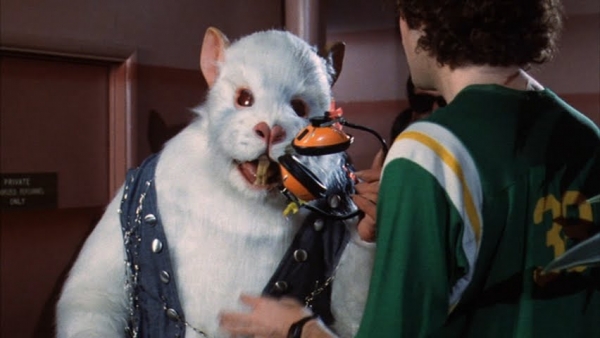
So anway, plot, before I go off on a tangent again. This has one of those plots that would work much better as a horror movie about an obssessive fan. The main character is fangirl Riff Randell (yes, her name is Riff) played by P.J Soles, and basically we watch her struggles to get to a Ramones concert. That's about it, but in all honesty, it feels more like a subplot than the main plot. In fact the whole film seems to be made of subplots. There's one about her best friend Kate trying to win over her crush, who in turn likes Riff. There's another one about giant rodents? I can't really remember, but what they were going for was the whole rock music corrupts, and decided giant rats would be the best idea.


Besides this, the main plot is over and done with all to easily. They get to the concert. Gee, never saw that one coming. Then this whole other plot takes over about the dictatorial principal of the school becoming even more dictatorial. And then they blow up the school. The end. It tries to be funny in new ways, but in the end they become cliches and go nowhere. Also, there are some really iffy scenes. There's one scene in which Riff fantasises that the Ramones are singing to her in her room. Ok, little weird, but not that unusual among fangirls. Then she imagines them singing to her while she's in the shower. ...What. Who made this! Oh, that's right. Roger Corman.

I should probably explain who Roger Corman is for those who don't know. Corman is the king of B-movies. He is responsible for a lot of the alien and monster movies of the 50s, he's also responsible for quite a few exploitation flicks. Knowing that he produced this, it doesn't surprise me that a scene in which a girl strips in front of three guys, who serenade her, and then follow her into the shower where she dons a towel has ended up in this movie. But it's still goddamn weird!


What this films suffers from the most is the fact that it thinks it's funny, when in all honesty, it's just weird. And not quirky or bizarre, just boringly weird. That's the other thing. Because the film spends so long on just Ramones songs, or musical montages and numbers, it feels a lot longer than it actually is, and the plot goes no where. Ten minutes of the film is dedicated to the concert, out of a 90 minute run time. Again, unless you are a massive Ramones fan, this scene will just drag on.

But ok, the plot was crap and kinda exlpoitative and weird, but why do I hate this film more than the others? More than Batman and Robin for chrissakes. Well, with Batman and Robin, it was god-awful, but it was also funny. It reminded me a lot of the 60s TV series, and was sorta fun in a mind bendingly terrible way, though that's for another review. In the case of Rock n' Roll High School, it's just boring! Cripplingly boring. It's the sort of film you're just waiting to be over with so you don't have to watch it ever again. I think I mentioned earlier that there were some scenes that have been completely erased from my memory, and partly that is because I watched this a while ago, but mostly because it was unmemorable in the first place.


In fact, the most memorable parts were the songs, but that's because they were forced down my ears so many times. So yeah, as I have stated many a time, die hard Ramones fans will love. Or die hard Roger Corman fans. If you're kinda meh about both, I'd give this a miss. In all honesty, it's not that horrendous. The dialogue (what parts I remember) was good, the acting was watchable and it was well shot. But if your film can't hold an audiences attention, then it's as bad as any other terrible movie. Except maybe Batman and Robin. Hmm, could I be hinting at the next review?

Thanks for reading, and I'm sorry if I offend anyone, but embrace your offence, understand it and don't come winging to me about it! Good night!

Saturday, 3 March 2012

Tyrannosaur


Wow. This film is one of the ugliest and saddest films I have ever seen. It is uncomfortable, hard to sit through and very, very depressing. But it is also one the best films I have seen. The cinematography is bleak and foreboding. The dialogue is harsh and full of swear words. And the characters are... well, let's just say they are some of the truest characters I have ever seen, with some of the best acing ever in any movie.

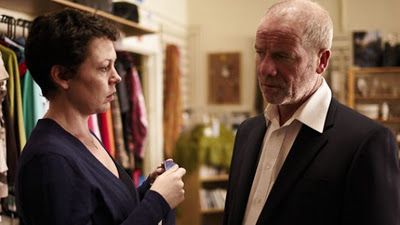
Now, this is not a pretty film. The story opens with Joseph (Peter Mullan) kicking his dog so hard that he kills it. And from there it gets worse. Joe meets a woman named Hannah (Olivia Colman), who works in a charity  shop, and slowly they begin a rocky friendship. I don't want to spoil the film, though if you see the trailer you have some idea, but what I will say is that Hannah is married to and aggressive and aggresive man. If you want more clues, watch the trailer.


This tragedy is one of the saddest films I have seen in a long while. I'm not joking when I say I wasin tears from the very beginning. But I found myself crying during the happier scenes, because the film builds such a sense of melancholy that you know whatever happy scenes there are you know they won't last long.

In terms of acting, I cannot believe that it took so long for people to give Olivia Colman a leading role in a film. Her acting here so perfectly captured the pain that Hannah feels, and the reluctant acceptance she has in a loveless and abused life.  For those who only know Colman from comedy roles, like Hot Fuzz and Peep Show, the depth she show in this dramatic turn may shock. In this film she is a woman on the edge, driven crazy by her abusive husband. Peter Mullan is also amazing as a man unable to deal with his grief and guilt and anger, who just seems to be waiting for his life to end on a downward spiral.


When these two characters meet, it is understanding and kindness that Hannah gives Joeseph. But as the film goes on these roles become reveresed as Hannah becomes more dependent on Joe. Remember when I said that these were some of the truest characters? Well, by that I mean that these characters are some of the most human characters to be portrayed on film. Neither of these characters are perfect, or even good people. They both have bad qualities and good. But you feel sympthatic, and in most cases empathetic, towards them because you realise that they are good people who just have trouble hiding their flaws and finding someone to connect with, and are mostly trying to survive each day.

One interesting and unique thing that the film does is  the way it presents Christianity. Most Christians in films are portrayed as pious and overbearing. But Hannah, the Christian in this film, is kind and helpful, and looks out for others, possibly more so than herself. But as the film progresses, we see that she is struggling to remain true to her faith, and it becomes clear that she uses her faith as a mask to try and find comfort from the things that happen to her.


The only thing bad I have to say about the film is the ending. Tyrannosaur was originally a short film that got expanded, and the thing about short films is that they tend to end rather ambiguously because of their length. Now, I haven't seen the short film, but if I just say that the full-length film doesn't end so ambiguously, you should be able to fill in the blanks. I found that I had the same disappointment from the explained endings of some of the horror films I've seen. But in all honesty, the film couldn't have ended any other way.

Will I explain the symbolic and cryptic title? No, not the whole way. What you do need to know, is that the Tyrannosaur is not who you think it is, and you should be able to figure it out all yourself. I strongly urge everyone to try to see this film if they can. It's not for everyone, but hopefully there is something for you connect with. I'll say it again that is is not a nice film. It is incredibly bleak, and quite violent and intense. But it is heartwarming and will remain in your head long after you've seen it.

Tuesday, 21 February 2012

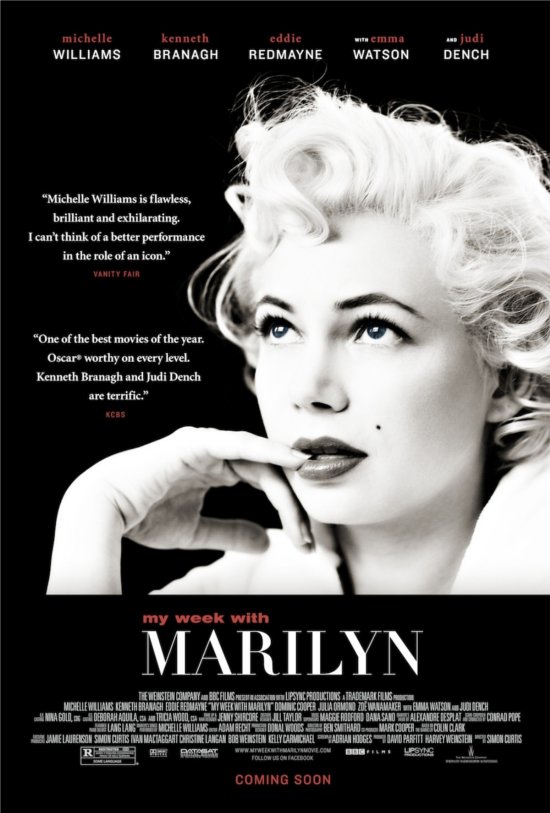
My Week with Marilyn (actual review)


Yay, at last a film I actually wanted to see! This has to be the simplest out of the three so far, but it has been the most enjoyable. I'm not sure what that says about me. Anyway, this is a really lovely film. The acting is superb, the cinematography is glorious and its really well written. There isn't as much substance to it as Shame, which was throwing symbolism at the audience, and it's not as long and boring as J.Edgar, but it is a well made film and I would reccomend to anyone who's interested. 

The best films about famous dead people, I have found, are the ones that focus on a single event or aspect of that persons life. While this isn't always the case, and there are exceptions to both sides, this film is is definitely one that works well. Instead of trying to tell the detailed story of Marilyn Monroe's life, instead we are given a "montage" of the time she flew to England to star in The Prince and the Showgirl with Laurence Olivier, narrated by his third assistant director, Collin Clark, who kept a diary during the shoot. This is a very effective way of telling the story, as Marliyn's private life was very much in shadows while she was alive. But you can instantly tell that this was based on a diary, because in every scene Collin is there, showing that all this is from his perspective. This may account for the melodramatic acting and scenes that occur sometimes, usually at the hands of Kenneth Brannagh. 

Marilyn's past is not exactly addressed. There are lots of hints to the tough childhood she had, mainly through little phrases here and there in the script. Match this with Michelle Williams' amazing acting, and the end result is truly astounding. Williams actis the pants off everyone on the screen, looking and recreating Marilyn as if she were alive again. She has subtlety and depth, and especially the recreated scenes from The Prince and the Showgirl. You really do end up believing that she is in fact Marilyn and the actress disappears. 


With the other actors and characters, Judi Dench is of course brilliant. Though none of the other characters are in it as much as Marilyn and Collin, each of them do leave a lasting impression. Except for Emma Watson, whose part is so small she may not have even been in it. The rest of the roles, even the small ones, are made up of those faces so familiar to British film and TV. Toby Jones, Zoe Wanamaker, Derek Jacobi (just to name a few) all pop in and out. The only real problem I have with this is that all the other characters are so looked over in favour of Marilyn, but I suppose that happened because it is meant to be more of memoir film and the narrator was mostly concerned with Marilyn herself. Dominic Cooper's accent however, is quite awful at times. His voice moves all over the place and he comes off the worst out of the bunch. 


But Kenneth Brannagh is really the one who overacts the most and the best in this film. Playing Olivier, he relishes the role and you can tell he is having the most fun out of all of the cast. Newcomer Eddie Redmayne is also good as Collin. He's sweet and kind, and you can see his character grow in confidence throughout the film. 

And that's it really. No seriously. Like I say, this isn't a complicated movie, there isn't that much substance or symbolism, the acting is amazing and the script is hardly cliched at all. I know this may seem like a short review, but there isn't really that much more so say. But I will say this. Actors should see this film. They should see it to find out how to successfully portray a real person, they should see it to find out how to overact with out becoming laughable. They should also see it as a warning to not let fame rule someones life, and to not create a character that you can't live up to. 

That's it from me. Go and see it! NOW!

Monday, 13 February 2012

Shame (actual review)


In all honesty, I wasn't surprised that this film was on the list for the course. It's one of the biggest artsy films out at the moment, and it is laced with symbolism, metaphor and those long lingering camera shots from a shaky cam that people have to come to love so much. The plot of the film is not that important. It's more a character study of Michael Fassbender's character Brandon, and his sexual ... urges. Yeah, this film is rated R for a reason. Within the first ten minutes you are greeted with a naked Michael Fassbender. And I mean naked. 

But as I say, this is a detailed character study of a man who seems disgusted by what he does yet can't help but do it anyway. He shares a love/hate relationship with his sister, Sissy (Carey Mulligan), and it is when Sissy reappears in his life that the plot takes over. Their relationship is the centre of the film, and it is left ambiguous as to what their past relatioship was like. We don't get much back story whatsoever, it is all left behind doors that are only left half open. The siblings' relatioship is also quite ambiguous as to whether there is anything sexual between them.


The film portrays Brandon like a man with a disease that he is trying to overcome through the course of the film. We don't see him 'enjoying' having sex or masturbating (except from the obvious 'sexual enjoyment' we all get ;) ), to him it just seems like a chore almost. The films whole view of sex left a little confused at times. It was condemning Brandon for having casual sex instead of having long term relationships, and yet doesn't question Sissy's life. This might be because the film is from Brandon's perspective and that, while Sissy has serious issues, she is more accepting of her lifestyle. The whole film goes back to the character of Brandon, and how he can't accept who he is. 

When he does try to have a more meaningful relationship, he is unable to go through with it, which seems to say that he is unable of understanding and committing to love. Indeed, his relationship with his sister seems to support this fact. While he loves her, he can't stand to be around her because she reminds him of himself, and his own 'shame'. And yet while he harbours this great shame at what he does, hiding it away from his public life and acting almost prudish (one example is when he changes his sheets after his sister has sex in his bed), she is mostly fine with the life she lives, what Sissy really wants is the love from her brother that he refuses to give her. Sissy is a tragic character, and when she does try to reach out to her brother, he finds himself repulsed by her and to a greater extent himself. 

This film also deals with double identity, and how appearances can be deceptive. Brandon's boss and work colleagues have little to no idea about the sorts of things he gets up to in his spare time, and are almost shocked to think of him being a sex addict. There are moments throughout the film when we see that he is a pretty decent guy. He harbours this great problem inside himself, like someone with a drug or alcohol addiction, and it is with the arrival of his sister that this resentment for what he does finally opens up in a frenetic climax.


The acting is exceptional, with both leads working off each other and giving incredibly moving performances. This is a film that uses looks more than dialogue. In one of the best scenes in the movie, Carey Mulligan 'sings' a sparse and discordant version of 'New York New York', with Michael Fassbender looking on. The scene is just made up of close ups of their faces, but the emotions they betray makes it the most moving scene in the film. In fact, if Carey Mulligan is mouthing it, then it makes it an even more incredible performance. To be able to perform so perfectly such a moving piece without actually performing it is an amazing feat. Michael Fassbender also gives a masterful performance, and by the end, he seems to have visibly aged fromt the events in the film. 

Tech wise, the lighting and music is perfect, highlighting the emotions of the scene and creating a hostile atmosphere for the characters to interact in, and the music especially fits seemlessly into the scene. Most of the sets are white, or with bland colouring, giving a stark hospital-like quality. The shaky cam is used here, but it is used in a more natural way (as opposed to the rushed usuage in J. Edggar) and it enhances the understated performances.

There is a lot of sex, and quite a bit a lot of nakedness, but if you ca survive that (and are at least 18) then it is a good film to see. Don't be too put off by the R rating, but I would advise most to waituntil they are older to see the film. I felt my immaturity coming into some scenes, and there are some very uncomfortable moment. But all in all, it's a beautifully tragic film with outstanding acting and will leave you pondering it ages after.