Showing posts with label review. Show all posts

Tuesday, 29 September 2015

Pan (2015)


Peter Pan is one of my favourite books. When I was a kid, I would reread it at least once a year. I read about five different spin-offs, sequels, prequels, whatever when I was 12 or 13. I grew up with the Disney animated film, the live action 2003 film, and Hook. I have even sat through Return to Neverland more than once. Yep, I am a Pan Fan. So naturally, when I heard that a new retelling was coming out, I was pretty excited. For a while at least. Pretty soon after watching the trailers, I began to get really worried. Hollywood has not had the best run with re-adapting classic children’s books. Tim Burton’s Alice in Wonderland (2010), Oz the Great and Powerful (2013), and Maleficent (2014) have all been pretty divisive in their own ways. But Pan is by far the most divisive for me personally, and hopefully this review will tell you why. And just to make my job just a little harder, this review is going to try and answer two other big questions: was this a good film, and did I enjoy watching it? Oh, and despite my best efforts, there will be a few spoilers! Sorry!


Peter (Levi Miller) is an orphan living in London during World War 2, when one night he suddenly gets kidnapped by pirates and taken to work for Blackbeard (Hugh Jackman) in Neverland. Blackbeard, obsessed with living forever, has hundreds of slaves working in mines trying to find pixie dust to help him stay young, leading to the destruction of most of the fairy population on Neverland. Once he is there, Peter discovers he can fly and escapes with the help of fellow slaves James Hook (Garrett Hedlund) and Mr Smee (Adeel Akhtar), who promise to help him look for his mother who Peter believes is somewhere on the island. The three of them set off to find the Tribal People, a group of warriors resisting Blackbeard’s destruction of the island. The find and befriend Tigerlily (Rooney Mara), princess of the tribe, and together they must stop Blackbeard before he destroys what is left of the fairies.

From the synopsis above, I’m sure some of you would’ve spotted the first major problem with the film. The plot is basically Star Wars. Peter is Luke, Hook is Han Solo, Tigerlily is Leia, Blackbeard is Darth Vader. Even Smee could be seen as C3PO. There is even a ghost that appears at the end to give encouragement to the hero and tell them that they did a good job. Copying the plot of Star Wars in itself is not necessarily a bad thing, but it does feel like the screenwriters were a little lazy. I think the plot would’ve been a lot better if they hadn’t decided to copy Oz the Great and Powerful and make the main character ‘the chosen one’ when there was no real need for it. It’s a trope that is used too often, and rarely in a good way, and again, it feels really lazy.


Some of my problems with the film can be put down to me being really nit-picky, but some of things I’m going to talk about now were just weird or stupid. Biggest one, why was Hook American? Why was he a cowboy? It just really bugs me a lot that such an iconic character was changed so drastically for no real reason other than the makers wanting to appeal to an American audience. I probably wouldn’t mind if I thought the actor did an okay job, but Garrett Hedlund just didn’t. Most of his screen time was spent mugging to the camera.

Hook was the biggest disappointment in terms of character, mainly because while I do have problems with other characters, they also had qualities that redeemed them in some way. There was quite a lot of CGI used in the film, which I get, but it did bring the film down for me a little because I prefer practical effects to CGI stuff. Also, it seemed that there was quite a bit of borderline child-abuse going on. I’m fairly sure that by the end of the film Peter would have broken most of his rib cage from the amount of harm he came to. The dialogue was kinda painful in a lot of parts, and there were a lot of heavy-handed references to the book that were just embarrassing really, and not necessary. I'm also fairly sure that the costume designer was on LSD.

 
There are two really odd moments that I just want to mention quickly, one I understand, the other I cannot comprehend. The one I understand was during the pirates attack of the Tribal People, instead of dying, the Tribesmen exploded into paint. Okay. I get that it’s a kid’s film and the director didn’t want to show any blood, but it’s just a bit jarring when you show Tigerlily taking out a pirate with her blades moments before the first paint explosion. The other moment is when Peter first arrives in Neverland, the miners and pirates are standing all over the mines singing “Smells Like Teen Spirit”, and then Blackbeard comes out and joins them. What? While I admit it is fun to see Hugh Jackman going a little bit crazy, why the hell was that song used? It’s never explained how they all know that song, why they have to sing it, and why that song in particular is important to Blackbeard. It just raises questions, and it surprised me so much that I felt alienated from the sequence. It’s just a really weird scene, and again not really necessary.

But the biggest problem I have with the film is what it actually should be classified as. I can’t see it as a prequel because it just brings up too many questions, like why is it set during 1940? Why are Peter and Hook still friends by the end of the film? Why does the ending have no foreshadowing to the end of the original? Also being a prequel to Peter Pan is kinda redundant for two reasons. Number one, and all prequels suffer from this, is that there is no tension during the climax. Everyone who knows the story can guess that everyone will end up okay, with no major deaths or anything like that, so the climax ended up being a mediocre CGI fest. The second reason is that Peter Pan already has a backstory, a really good one, one that explains the motivations of the character and how he came to be Peter Pan. Inventing a new one, again, is not necessary!


So then I guess we call this film either a reimaging or retelling. But then why advertise it like a prequel? A lot of people were disappointed with this film, and I think advertising this film as a straight up prequel is why. Does it work as a reimaging? Sort of, but it suffered from a plot that was too Hollywood-anised for it to feel like a new story. Like I said earlier, Oz the Great and Powerful already did a prequel featuring a 'chosen one' plot, and that film probably borrowed that idea from Alice in Wonderland. I don't get why they didn't just film Peter's backstory as it was in the book, but apparently that would be too easy.

But with all these things against the film, I do think there were some really good things in it as well. Hugh Jackman was practically electric as Blackbeard, bringing a lot of depth to the character that would otherwise have been lost with another actor. There were a lot of small character tropes that weren’t spelled out or expositioned over, instead just shown through the characters actions. Tigerlily was pretty bad-ass, and her fight between Blackbeard was one of the highlights of the film, though she does suffer a little from lack of personality. Levi Miller was extremely likeable, and for his first major role I applaud him for saying some atrocious dialogue with a straight face. Kathy Burke is hilarious in a supporting role, and was probably my favourite character in the film. The cinematography was really nice, the fight scenes excellent, the music was good. But most importantly, kids really enjoy this film.

 
I saw this in a cinema full of kids, and I think they were all entertained. The kid in front of me couldn’t stop saying how good a film it was, and some girls behind me said how awesome they thought Tigerlily was. And hopefully after seeing this film, it will inspire them to go and read the book, which is the most important thing a film like this can do. So after all this talk, how can I answer the questions I asked at the beginning of this review?

Is this film a bad film? Well, let’s put it into perspective. Comparing it to the other films I listed at the beginning, it is miles above the migraine inducing Oz the Great and Powerful, but it doesn’t make as much sense as Maleficent, which was very clear in its intent despite its faults. It comes closest to Alice in Wonderland I think. I don’t think it’s terrible, but it could be a lot better. As to whether or not I like this film, I don’t know if I can answer that question, at least not at this moment. I was entertained while watching it and I don’t regret seeing it, but the source material is so close to my heart I’m not sure I can ever fully like it. I guess all I can do is wait a while and see how I feel a few months from now. I might even need to see it again before I form a solid opinion. But one thing I can say is that, for all its faults, Pan did inspire me to start writing again.

If you are interested in seeing it, then do. There are worse films out there. I’m sorry this was such a long review after months of inactivity. I really didn’t mean to write so much, it just kept coming. Not sure what I’ll be doing next. Maybe a list, who knows? If you stuck this out to the end, well done. Until next time, readers.

Saturday, 16 August 2014

MIFF 2014: Patema Inverted


There seems to be an increase of animated films being shown at MIFF, and I am so happy! This was the only one I got to see, since none of the other times suited me, and they were selling out fast. Speaking of selling out, the session I went to of Patema Inverted was sold out. Which is awesome! Although it did mean I had to sit next to a whole bunch of people who didn't know how to turn their phone off.

Anyway, this is a fairly confusing film to try and summarise in a few sentences, but I will do my best. Patema is a teenager living in an underground world of caverns who, against the wishes of the Elder, goes out exploring in what is known as the danger zone. One day, she comes across a being who is standing on the ceiling and she gets knocked into a pit that takes her to the surface world. Here she meets a boy called Age, and discovers that while gravity works as normal for Age and his people, for her gravity is reversed and without being held down she could fly off into the sky. The leader of Age's world wants to get rid of every 'invert', as he sees them as sinners. So, the race is on to return Patema to her own people, while also preventing her from flying away.


Like I said, a bit confusing. But it is a good film that works through a difficult concept. The film doesn't go out of its way to explain everything that is happening, which can be both good and bad. I know there were times when I was scratching my head, wondering what the hell was going on. But by the end you have a pretty clear idea of what happened.

And can I just saw, the animation in this is breathtaking! I know everyone goes on about how How To Train Your Dragon and its sequel are able to animate flying so brilliantly, but while watching them I never got that gut feeling of being lifted into the air that I did during this film. And the method for flying is really interesting and different, and ties in well with the rest of the film. Patema and Age discover that by holding onto each other, they each become lighter since they are using each others gravity to move. I think.


The way the setting is designed is also really cool. There are some steampunk elements here and there, which makes me very happy. I guess the biggest problem I had with the film was the voice acting. I saw the original dub, and generally everyone was pretty good. But there were a few moments near the beginning where I swear the voice actor for Patema was trying to destroy my eardrums with her shrillness. She got better as the film went on, but it was very annoying to begin with.

So, this was a pretty excellent film, with brilliant animation and a complex but intriguing concept that the film explored really well. The film also talked about how religion can blind people from understanding others plights, which is a good message to give in this day and age. Apart from some problems I had with the voice acting, this is probably the best animated film I've seen all year. There are some scary moments, so really little kids might not like it. But for older kids, and people who like good sci-fi, check this out.


I'm writing this blog on the last day of the festival, so the chances of anyone seeing the last of these films is very slim. But I did set myself a challenge to write on every film that I watch, and I don't plan on ending it now. I have three more films to write about, and they should come out in the coming week. Hopefully. I might have an essay that requires me to concentrate on it rather than writing these silly little blog posts. But we'll see. Until next time, readers.

Friday, 15 August 2014

MIFF 2014: Obvious Child


Okay, to be perfectly honest, the main reason I wanted to see this film was because of the director. Or, to be more specific, the director's name. Her name is Gillian Ropespierre, and if that doesn't also make you want to immediately see this film then we can't be friends. After watching the trailer, I was intrigued into what sort of film this would turn into, since it's tackling a subject that is quite controversial in America, abortion. And it's a comedy. How could this work? Could this work? Well, I am pleased to say that it can.

Donna (Jenny Slate), a comedienne who also works in a bookshop, is dumped after one of her sets by her boyfriend, who also reveals that he has been cheating on her with one of her friends. After having a one night stand with Max (Jake Lacy), Donna discovers that she is pregnant and, realising that she isn't ready for motherhood, decides to have an abortion. Meanwhile, as she and Max grow closer, she tries to tell him of her decision, while also trying to get a grip on her quickly deteriorating life.


First up, this film tackles a subject that most rom-coms shy away from in both a funny and honest way. Most rom-coms that revolve around unexpected pregnancy don't even consider other options to having the baby, despite how immature the parents may be. And, most importantly, Obvious Child doesn't condemn Donna for deciding to get an abortion. And I applauded the film for taking a controversial subject and not making it a message film. It's not about being pro-choice or pro-life, it's just about one persons decision. It doesn't treat it like a be all and end all situation, it's just another event in her life that she learns and grows from.

But I think the crowning glory of Obvious Child is the way it takes quite a serious subject and making it funny! And this film is pretty hilarious! I think it was Kevin Smith who once said "The big bucks are in dick and fart jokes". If that is the case then this film should make millions. Most of the humour is dialogue and character based, but it's centered in a realistic setting, which basically means that the film doesn't go out of its way to create comedic set-points that would not happen in real life. That being said, most of the dialogue is full of bodily fluids, genitalia, and of course, dicks and farts. And it is gloriously funny!

 
Unlike other films that uses crude, gross-out humour to make shock jokes that aren't actually that funny when you get past the shock factor, Obvious Child uses this sort of humour for the characters to hide behind. Donna herself has problems talking face to face with people, and so uses her comedic routines to address the important issues in her life. And again, this masking humour is used in the conversations between Max and Donna, where they tease each other instead of talking about things that need to be talked about.

This way of using humour creates a vulnerability in Donna that is both relatable and honest. And this also comes through in Jenny Slate's acting. I haven't come across Slate before, apparently she was in Parks and Recreation, but I haven't watched that... yet. I hope she does some more films, and I also hope that Gillian Robespierre makes more films, since this is one of the funniest American comedies I have seen in a long while. It was also nice to Gabby Hoffmann in a role after years of not doing much. And here, playing Donna's feminist amd free-spirited roommate, Nellie, she really has come a long way from her roles in pre-teen melodramas.


I suppose I should also talk about the romance briefly, and it's not bad. The biggest complaint I have is that Max does come across like a saint at times, which is a problem a lot of rom-coms have. But I am glad that he and Donna don't do the whole 'love at first sight' thing. There is an attraction, there is sex, but the relationship part takes time to grow and develop throughout the film. And there is a chemistry between Slate and Lacy that makes their interactions seem natural.

So, if you're tired of the general paint-by-numbers rom-coms that are still being produced, then you should check this one out. The characters are awesome and realistic, the acting is great, it tackles a controversial subject while also making dick and fart jokes. What more could you want? Until next time, readers.

Thursday, 14 August 2014

MIFF 2014: Life After Beth


Zombie comedies is my favourite sub-genre of horror films. So naturally, when I heard that one was on offer at MIFF, I got excited. And when I saw the title, I got more excited and also got some tickets. And last night, I got to see this little indie comedy.

The film revolves around Zach Orfman (Dane DeHaan), who is still mourning the loss of his girlfriend Beth Slocum (Aubrey Plaza), when she suddenly comes back to life with no memories of her death. Despite being initially freaked out, Zach and Beth resume their relationship. However, Zach soon realises that the newly alive Beth is not the same Beth that he used to know. And just maybe, the zombie apocalypse is also happening.


So, the thing with comedy is that it is subjective from one person to the next. What one person finds funny, someone else won't. Me, personally, I don't like films in general where characters shout over the top of each other in an attempt to be realistic (looking at you, David O. Russell). Life After Beth unfortunately does this. I just don't see why you would have everyone talking at once when you're comedy is based predominantly on dialogue. If you can't hear the dialogue, then you can't hear the jokes! This was the one big flaw of the film for me, but I do understand that it is also a personal pet peeve. If you like films like that, well done! You will probably enjoy this one.

Anyway, moving on after that rant, what are the good things in Life After Beth? Well, for starters the cast is amazing! Especially Dane DeHaan and Aubrey Plaza. I see both of them becoming big stars in the future. And if they don't, then the world is crazy! Other actors that should be mentioned include Matthew Gray Gubler as Zach's older, trigger-happy brother Kyle, John C. Reily as Beth's overprotective father who can't understand that his daughter is turning into a monster, and Anna Kendrick, who has a small role as a parody of those girls that One Direction sing about. The rest of the cast is made up (presumably) well-known American comedy actors that I haven't really heard of.


I do have to say that despite my rant earlier, this is a very funny film. Which is good, because there really is not a lot of plot, but because the action of the film is made up the characters reactions to situations I can overlook that. The fact that the zombie apocalypse is treated in such an upper-middle class manner makes the jokes more interesting and funny than if everyone's reaction was based in reality. And there are some really funny moments dealing with the zombies themselves and how they are deteriorating. The way zombies are treated themselves is pretty interesting, as they come back normal, but become more aggressive and violent the longer they stay.

All in all, the new way of dealing with zombies and the mix of very American, suburban humour makes Life After Beth a really good film. Aubrey Plaza is awesome, and any flaws in the plot is made up for with the acting. If you like zombie comedies, or genre films in general, or indie films, then I would recommend this one. Until next time, readers. 

Sunday, 10 August 2014

MIFF 2014: When Animals Dream


It seems that the countries leading the world in terms of horror films are the Nordic ones. In particular, Norway and Sweden have produced some excellent horror and genre films within the last ten years, including Troll Hunter and Dead Snow. Now, Denmark has joined their ranks in producing an excellent werewolf thriller, that is both intelligent and chilling.

When Animals Dreams focuses around a young woman, Marie (Sonia Suhl), who lives in a small fishing community with her father, Thor (Lars Mikkelsen), and her wheelchair bound mother (Sonja Richter). When she gets a job at the fish processing factory to help her parents, Marie starts discovering strange changes in her body, starting with a rash on her breast. As the changed become more and more prominent, Marie starts exhibiting odd behaviour that startles others in her village. She also discovers these changes may or may not have something to do with how her mother ended up in a wheel chair. Eventually, the townspeople start hunting her down as a means to protect their community.


What good films do is present exposition in natural ways, that don't clunk up the narrative. They also let the audience use their brains to figure out what may be going on. This film does that, slowly unraveling the mystery of what is happening to Marie as she, and by extension the audience, come across each new piece of information. The word werewolf is never used, nor is it explicitly spelled out what actually happened to her mother, but through the information we are given, it's not hard to see what's going on.  It's very clever the way the film never gives full answers, just enough exposition to hint at what is going on. You rarely see films like that nowadays, let alone horror films.

Well, if that's what good films in general do, then good horror films take advantage of the supernatural creature/force/thingy and have them represent a certain aspect of society or whatever. And When Animals Dream does this as well. Now, as with any film, it could be interpreted in many ways, so this is just my interpretation. But for me, the werewolf and the changes going on in Marie represent female coming of age, and embracing your individuality and identity. This theory is strengthened by the fact that Marie, once she does start transforming, fully embraces the animal inside her. The townspeople's reaction, that of violence and condemnation, could represent the power of conformity and the suppression of female freedom. Again, just my interpretation. But it is nice to have a horror film where such interpretations can be made.


So, what is the most important part of a werewolf film? The special effects. And the effects that they use here are very subtle. We, unfortunately, never see a full transformation. But the snippets we do see are very well done, using both computer effects and make-up. The make-up here is used really well, as small changes are added to Marie's body and face, just to hint that something is happening. And her transformed look retains her human body, while her stance and face change drastically. It's a really effective, and different way to show a werewolf onscreen.

The cinematography is also really good, with some breathtaking views of Danish coastline. But it adds to isolation of the village, and the danger that Marie is in when she tries to leave. Through the isolation of the place, a tension runs throughout the film that builds until the climax. Its really effective, but it makes the film less outright scary and more subtly haunting. Which is good, because horror films that rely on jump-scares get really boring after a while.


So, if you're looking for a smarter horror film or just an excellent retelling of the werewolf story, then I would definitely recommend this. The gore is not overt, there are few bloody moments here and there, but for most of the time the film relies on atmosphere rather than gore or jump-scares. The story is excellently told, the acting is really good, and the cinematography is beautiful. Not you typical werewolf film, but much better for it because of that I think. Until next time, readers.


Monday, 18 February 2013

Mediocre Movies: The Parole Officer


So, let's talk about Steve Coogan for a moment. I'm not his biggest fan (though my friends may not believe me), and it's mainly because I don't like the awkward comedy wheel to which he revolves. But that doesn't mean that I don't like some of his stuff. Like 24 Hour Party People or even Around the World in 80 Days, which is probably one of the worst adaptations ever made (and one day we will get to it). I still don't understand why he appears in so many kids films, and always in supporting roles. Well, apart from The Wind in the Willows. Wow, doing this introduction has made me realise just how many films of his that I've seen. Anyway, let's take a look at Coogan's first staring role directed by Australia's own John Duigan.

Probation officer Simon Garden (Coogan) is forced to move from Blackpool to Manchester after everyone in his department complained against him, and then just to make his day worse he witnesses his boss, Detective Inspector Burton (Stephen Dillane), murder an accountant. Now, the only way to clear his name is to steal the security tape that documented the crime with the help of George (Om Puri), Jeff (Steven Waddington) and Colin (Ben Miller), his only three successfull probation cases. They are then joined by Kirsty (Emma Williams), a feisty teenager who had drugs planted on her by Burton, and they get help from police officer Emma (Lena Heady). But will they be able to get the tape out without getting arrested in the process? (Obvious spoiler: They get the tape.)


So, by now you've probably noticed the first problem with this film. The main character is a probation officer rather than a parole officer. I guess The Probation Officer didn't have the same ring. The second problem with this film is that it's very predictable, but one shouldn't hold that against it. There are a lot of enjoyable films that are incredible predictable, and no one seems to care. It's the parts in between, the deviations in the script from other films in the same genre. And how does The Parole Officer stand up when viewed from that light? Well, a little hit and miss. There are some obvious jokes that they make at times, including one scene with a statue and a giant penis featuring a cameo from Simon Pegg. But the actual heist is quite ingenius in parts, mainly because the gimmick for this heist is that they're all amateurs and barely know what they're doing. For example, instead of ski masks they use insect masks and crazy string to block up the cameras.

Of course, this does mean that the heist is the best part of the movie, which is true. The forced romance between Coogan and Heady is just that, forced all the way. And in a really awkward, embarrassing way as well. Considering Coogan wrote this, I can only assume that he just wanted a make out scene at some point. Apart from Heady's character (who really is wasted in this), the other side characters are really fun, especially the crew that Simon puts together to rob the bank. And out of them, especially Emma Williams as Kirsty, who is the smartest out of all of them, really. The villain is nicely camp, but not overly so. He is able to be menacing when he needs to be. And he does have some of the best lines.

 
But now we come to the crunch. Is this mediocre? Well, kinda. If you're a fan of Coogan, or of his style of comedy then you should like this. If you like heist movies, even the silly ones, or parody movies then this might interest you. But otherwise, I'd give this a miss. It's by no means terrible, but it is rather ... predictable. I'm sorry, but that is one of the most accurate words to describe it. But now that I can put my critic hat away, I'm going to say that I do really like this film, awkward Coogan moments and all. Call a little bit of a guilty pleasure. Though I do think that the side characters are better than the main character, which is not generally a good thing.

So, to end this little review, I'm just gonna say that if you want something a little silly to pass the time, then this could be it. I do know it has cheered me up in the past week while I've been lying on my arse feeling sorry for myself. Dunno what will happen with this blog after next week when I start uni for the first time. Which I'm still a little apprehensive about. Wish me luck, readers. Until next time.

Sunday, 16 December 2012

Problems I had with 'Perks'


Yes, I have now seen the new teen-angst hipster movie, The Perks of Being a Wallflower, based on the book by Stephen Chbosky, who also directed the film. And if you haven't guessed from the title, it fell a little flat with me. It wasn't terrible, but it wasn't great. Really, the only compliment I can give it is that it's competent, and even that is stretching it a little. Basically, it just could've been so much more, but I didn't connect with it. And I would like to examine why that is. If you did like it, good for you. Maybe you could answer some of these questions that interrupted my viewing of the film. Yeah, I can't be bothered and I don't have time to right a full review. And I'm just going to guess that most of you know the plot. If you don't, watch the trailer. Gives you enough information on it. Oh, and they aren't in any particular order.


1. Did they seriously not know that David Bowie song?

Okay, this is just me being a little nit-picky and annoying, but this frustrates me. During a tunnel ride, the song "Heroes" by David Bowie is playing on the radio, but for some reason, none of them recognise it. Now I know that the song didn't create that much of an impact when it was first released, but by the 90s it had gathered a lot of respect, and had appeared on about 6 best of CDs by 2002. The only explanation I can come up with is that the three main characters' musical tastes is so alternative that David Bowie has somehow slipped their radars.

2. What happened to Patrick?

Halfway through, after his big emotional breakdown, Patrick (Ezra Miller) just kinda disappears from the movie. And we don't hear anything else about him. We get no closure for the character! How does he overcome his depression? Does he find someone else? What the fuck happened to him! I guess this just shows how little invested I was with the main character that I desperately wanted to know what happened to one of the supporting characters.


3. Was there any point to Joan Cusack being in this?

I mean the actor, not the character. Didn't think so. It's just distracting to see her pop up five minutes before the end of the film.

4. We needed more Melanie Lynskey and Aunt Helen

I really like Melanie Lynskey, ever since I saw her in Heavenly Creatures. And it's nice to finally see her in something other than Two and a Half Men. But the flashbacks involving her character are so brief that she might as well not even be in it. And it would be really helpful if Aunt Helen got a bit more screen time. Whatever we do learn about her is more implied than outright said, and it's just bloody frustrating rather than intelligent. And it brings me to my next point...

5. The final twist is not clear enough to have an impact.

Yes, this movie has a twist. There will be spoilers. I know that it's better to show than tell in films, but the final part of the film really shows Chbosky's inexperience as a director. Because what Aunt Helen did is never explicity said, I was left with an implication that came out of nowhere. This is why we needed more scenes with Helen, so that this twist would fit in more with what we would have learnt from her character. Because we don't learn anything, the twist becomes confusing. Also, because it is presented so incompetently, it doesn't have the impact it was meant to. Plus, it seems to be fairly exploitative, pulling a child abuse back story straight out of its arse. Which brings me to my next point...


6. The movie tries to hard.

Yep. It really does. All the teenage characters are indie, they're outside the group, but all that we know of 'popular/normal' is what the movie deigns to show us once in a while. It tries so hard to tug at your heart strings and relate to you that it loses a lot in terms of plot mainly (see previous point).  And it falls into so many cliches of other teen films without bringing anything that different. There's an inspirational teacher, there's a falling out of friends halfway through, there's the standing up to bullies. In all honesty, it's boring. The one good thing about the film, and I wish they had spent more time on this, was Charlie's family. They were there for him, concerned for him all the time, they helped him through his problems. And I'm not talking about just his parents, his siblings are there too. It's the only refreshing thing in the movie.

And now my last point.

7. When the fuck was this film set!

I'm serious! This pissed me off more than anything! We never got a fucking year! Is it too much to ask for! I think it was set somewhere in the 90s, but it could've been the 80s, or even early 00s. Please, if you do reply to this, please tell me what fucking year this is set in!


Anyway, that's it. I know I should've done a review, but I'm guessing those who wanted to see it already have, and won't care what I think about it anyway. With Christmas coming, hopefully I'll get another one up during the week (if I don't procrastinate and watch Christmas movies all day). This one should be Christmas themed. Until next time, readers.

Tuesday, 11 September 2012

Moonrise Kingdom

 
I hate the word "indie". To me, it doesn't really mean anything and it associates itself with people who think they have better taste because they like things that are slightly more obscure than mainstream. To me it is a derrogative term, so I won't call this film indie. Instead I will say it is original. Well, only if you haven't seen a Wes Anderson film before. I didn't really know how else to start this one. I could talk about the director, but I already did that in my Bernie and Trishna reviews, and I do so hate repetition. Also, in talking about Anderson's other works I'll just end up comparing this one to them, which every other reviewer is doing and I hate cliches as well.  Well, I could go straight into the plot, but then that would break up the loose structure that I normally use. Naming the film, and the director, seems a little redundant now, since if you've read this far then you know those facts already. If you know anything about the film then you probably know the basic plot already, but I will go on with a brief synopsis in the next paragraph, as I think this shameful introduction has run its course.


12 year-olds Sam Shakusky (Jared Gilman) and Suzy Bishop (Kara Hayward) are two outcasts living on the (fictional) island New Penzance, off the coast of New England. Over the course of a year, they correspond secretly and run away together during summer, much to the concern of Suzy's lawyer parents Walt (Bill Murray) and Laura (Frances McDormand) and Sam's scoutmaster Ward (Edward Norton). The two kids enjoy a couple of days of complete bliss away from the adults that run their world, while the Bishop's, Ward and the island's policeman, Captain Sharp (Bruce Willis), are desperately trying to find them. What plays out is a story about finding love and a place where you're happy as seen through the eyes of two children, an exaggerated truth about chilhood during a time when parents were finding it hard to connect with their children.


So, I have a problem with this film, and I don't really know how to talk about it (you might've guessed that from the introduction). Partly, I think it's just writers block, but I really don't know what to say about this film. Which is odd, because I really liked it. I liked it so much that I am seriously considering putting it on my end of year best of list (yes, that will be done). It is a really good movie, and one of Anderson's best. But, again, I can't find the words to describe it. I suppose I shal have to be boring and just say why I liked the film instead of giving a semi-deep analytical view. Well, I do like the premise. Two twelve year-olds who fall in love like adults, it is very different and one of the best premises I've heard since Harold and Maude. I like the way the adults of the film are portrayed like kids, particularly Edward Norton' Scoutmaster Ward, who seems to lead an unfulfilling adult life, so he spends his free time being an almost dictatorial leader for a group of kids, and instead lives his life to a strict regime with needed to be broken up by the main characters escape. If you hadn't guessed, Ward is my favourite character.

The other adult characters all have something missing in their life, and while some of them aren't neatly fixed by the end, you do get the idea that they will try to do better with their lives after this event. So, what else did I like? The trademark Wes Anderson panning shots are always refreshing to watch, and I am once again aware at how well timed they all are. And of course the minutest detail is carefully planned out. I particularly love all the books that Suzy reads out, with each cover designed by a different illustrator. I also like the way it's directed, with both children showing dead-pan emotion most of the time, while the adults run around almost hysterical at their absence. Of course, my heart is warmed by the scout boys who come to Suzy and Sam's rescue, even though before Sam was incredibly unpopular and didn't get along with the rest of the boys. I suppose it just shows that some things, like outcasts and bullying, are always going to be around, hence why we get so many coming-of-age stories.


The acting is excellent, with very underrated performances from the kids, and the adults nearly overacting. I have to highlight Jared Gilman and Kara Hayward as Suzy and Sam, who really excel and I can't wait to see them in something else. I already said that I liked Edward Norton (like is too weka word, madly in love is more appropriate), and Tilda Swinton as Child Services is also quite fantastic given the little that she does. But I think the best is definitely Bruce Willis, playing against his "die hard" action star character. If you've seen Death Becomes Her, then you may guess what he may be like. I also really like the colours of the world that Anderson creates. His palette is very much based on muted primary colours, again enhancing that child-like quality.

Well, I've managed to write about something. I suppose I'd better say what I got from the film, and maybe that will uncover why I find this film so hard to write about. Well, the main thing I got out of the film was a sense of longing for the past. Let me explain. For a few short day, Sam and Suzy spend time together being able to be whoever they want without judgement, and from that a love grows. After such a short amount of time, they are dragged back to reality, and both of them seem to know that while things will never be the same, they will never have the time they had during this one summer ever again. And at the end of the movie, you feel that there is overwhelming sadness between the two kids that they will never live those days again. It makes this film sad, and to add to the sadness the mournful music of Benjamin Britten, whose compositions for children litter the film and add a personal touch from Anderson, who grew up with that music.


So, why did I find this film so hard to write about? Well, if you recall, I said I had a problem with it, and that is that while it is incredibly entertaining to watch while you're watching, it doesn't leave as great an impact when you leave the cinema. It's hard to explain why, and it's not as if it leaves you with nothing to think about, but it leaves you wanting something that it didn't give you. And with a rather sad ending to boot, this falls a little in my love for it. I still think this is an exceptional film, and one that really should be seen. I am sorry if this review turned out to be a little existential, but writers block is a terrible burden to bear. Also, I don't want to spoil for those of you who haven't seen it yet, so I kinda mentally blocked some things while writing. So, yeah. Nothing more to say, really. Until next time, readers.

Tuesday, 4 September 2012

Holy Motors


... Um... Er... Uh......... Merde. Ben, je pouvais ecriver la revue en francais, mais I really can't be bothered and I've pretty much exhausted whatever high school French I had left in me. If you hadn't guessed, this is a French film from director Leos Carax and I have no idea where to begin with this one. I mean it. On the poster it says "One of the most original films of the century", and I'm very inclined to agree. I don't think anything like this will ever come again. The only way I can describe watching it is like watching a Jean-Pierre Jeunet film on acid whilst being repeatedly hit over the head with the Beatles' "Revolution No. 9". Your head hurts after and you have no idea what you just say through.  

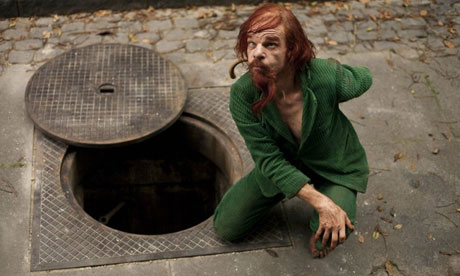
Holy Motors follows one day in the life of M. Oscar (Denis Lavant) as he is chauffered around Paris in a white limousine by his driver Celine (Edith Scob). We see him going to his different appointments during the day and way into the night. The appointments are tied together through the conversations and interactions of M. Oscar and Celine as they drive to the next appointment. Because of that, it feels like lots of little short vignettes joined together loosely forming one incoherent whole. Though it soon becomes clear that Oscar's busy schedule is draining him and he is slowly loosing his will to carry on. Some of his appointments include kidnapping a doll-like model (Eva Mendes), going into a motion-capture room, picking up his 'daughter' and playing a dying uncle with another associate.


Since I have nowhere else to start, I will begin with the acting. I haven't seen Denis Lavant in anything before, though I know that he has been in all but one of Carax's films previous to this one. This has to be the best performance of the year. Lavant doesn't just play Oscar playing other characters, he plays 11 different, fully fleshed characters (or as fully fleshed as they can be given the time) and yet is still able to show us that he is slowly losing himself with every new role that he takes on, and it becomes apparent that he is living his life through other people. He has been doing his job (which is never fully explained) for so long that he is starting to lose not only his motivation, but whatever part of himself is left. The other actors are good, especially Edith Scob as Celine, Eva Mendes as Kay M and rather surprisingly Kylie Minogue as a former aquaintance/lover of Oscar's.

Visually, this looks pretty amazing. Paris looks fabulous at night, and we see some back streets and landmarks that you don't usually see when someone films in Paris. But the cinematography is especially great in the motion-capture scene as it shifts between normal and slow motion so seemlessly. The music is also good, when it's there, as the film mainly uses a natural soundtrack, and every song used is used for a specific purpose (though I do guarantee that Kylie Minogue's song will get stuck in you head for ages after). In fact, my favourite part of the film might well be the intermission because of the great accordion break down!


But that's the thing with this film. Because of the vignettey style it's hard to look at this as a whole, at least for me it is. I'm not going to pretend for a minute that I know what this film is trying to say, like some other critics have, littering their reviews with stupid phrases like "I can't tell you what is going on because then it would spoil your viewing of it". I don't know what is going on (well, I do in a story sense, but not a thematic sense), but instead I will give two theories that may be right, but probably aren't, in order to shed some light on the film.

The first is what I thought while watching the film in the cinema, and that is that all these appointments are for an unseen audience that can only experience life through those who work for the company Holy Motors, those like Oscar. This come through the opening scene of a cinema audience watching a movie (and I will say that it is very disconcerting to watch an audience watching you watching them... try and put your head around that one), and also through a conversation with Oscar's boss, who says that he is losing his touch, obviously referring to his acting. Also, Oscar is portrayed as a never dying being, who seems to be put through these bizarre scenarios for someones perverse pleasure. And some of them really are perverted, especially the one with Eva Mendes as supermodel Kay M, who is kidnapped by a disgusting sewer creature.


The other theory, which was brought forward during my film groups discussion, is that this could all be a dream. And it really could be. This is a very surreal film, with none of the parts connecting except for oscar, yet each part tells a distinct story in itself. The dream theory is very probable and not just a way of admitting that I don't really know what it all means (I already told you that). For what if Oscar was having trouble at work, it might explain his stabbing scene. Or what if he's having trouble communicating with his daughter, that would explain her scene in the car. Or what if, a million other what ifs! I'm inclined to believe the dream theory, along with Carax himself has said about the film.

Leos Carax is behaving a little like David Lynch in that he isn't explaining anything about the movie, and when he does they are pretty cryptic. But he did say something that caught my attention: "You could say that Monsieur Oscar (played by Denis Lavant) is an actor, but it’s not a film about actors. It’s a film about a man and an experience: the experience of being alive. I used the fact that he might be a actor or a kind of actor that no one is watching: a little like all of us." While it doesn't really tell us that much more, to me it gives the film more of an autobiographical feel. Like he was trying to recreate scenes from his own life that he wished could've gone better, while also putting these surreal fantasies in there as well, that were maybe drawn from dreams he had. This is enforced by a number of things; the fact that he has a cameo as a man who finds a secret door that leads to a movie theatre, and that Oscar and one of his alias', Alex, is an anagram of Leos Carax. And if this is just a mad dream that Carax is having, then it explains all of the references to other movies that you can find in this.


Oh yeah, there are references to other movies in this. But you may not get them, I only got one. The good thing is it doesn't mean that you lose anything if you don't get them. This is a critics movie, so if you find that if you go and see it and get annoyed at reviews for calling it a masterpiece when to you it is a just mess, don't worry. This seems to be the Eyes Wide Shut of Cannes this year, but executed way better and not nearly as frustrating. Would I recommend this? Well, no, unless you were wanting to see it anyway. If you want to see it then do, I'll bet you won't have seen anything like it. But if this doesn't sound like your kind of thing, then it probably isn't. I'm still not sure if I actually like this. As I said before, there are parts I like, but as a whole I'm incredibly ambivalent. It would probably benefit from repeat veiwings, so I may borrow it when it comes out. I will say this for it though, it was so much better than Cosmopolis. Until next time, readers, in which we enter the indie circuit.